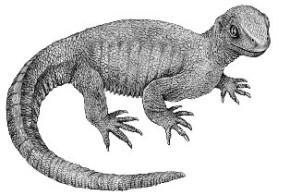


WASHINGTON: It looked like an odd lizard with a bulky body and only the skeletal precursor of a shell, but scientists say 240 million-year-old fossils unearthed in a quarry in southern Germany represent the grandfather of all turtles.
The scientists on Wednesday announced the discovery of the oldest-known turtle, a 20-centimeter (8-inch) Triassic Period reptile combining traits of its lizard-like ancestors with a set of emerging turtle-like features.
They named it Pappochelys, meaning “grandfather turtle,” owing to its position at the base of the turtle family tree.
“Pappochelys indeed forms a missing link for two reasons. It is far older than all so far known turtles. And its anatomy is more primitive in many features, showing the ancestral condition of various body regions,” said paleontologist Rainer Schoch of Germany’s State Museum of Natural History Stuttgart.
It is 20 million years older than the previous earliest-known turtle, Odontochelys from China. While Odontochelys boasted a rudimentary shell on its back, Pappochelys bore only the beginnings of this characteristic turtle trait that evolved in many steps over tens of millions of years.
“The belly armor is composed of thick, rib-like bones that are beginning to fuse to each other in many places,” said paleontologist Hans-Dieter Sues of the Smithsonian Institution’s National Museum of Natural History in Washington, calling this “an important stage in the evolution of the turtle shell.”
Pappochelys, known from 18 fossil skeletons, had a long tail, broad trunk and, rather than a beak as in later turtles, a lizard-like skull with numerous peg-like teeth suitable for eating insects and small lizards. It resided alongside a freshwater lake and may have used its tail for swimming and legs for steering in the water. Schoch said Pappochelys, as a transitional creature between lizard-like ancestors and later turtles, provides a much clearer picture of turtle evolution.

Karachi Port sets 138-year cargo handling record
KARACHI: Pakistan's maritime sector has achieved a major milestone as Karachi Port set a new record in its 138-year history...