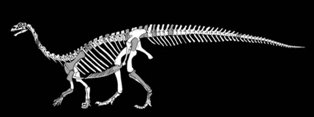


MALI: The remains of herbivorous Sefapanosaurus were unearthed in the 1930s but languished in a storeroom at Wits University until they were recently reassessed.
Palaeontologists in South Africa have discovered the fossil of a previously unknown dinosaur dating back 200m years. It was found not on a remote desert plain but in a university storeroom.
The specimen had been collected in the late 1930s and for decades it remained hidden among the biggest fossil collection in the country at Wits University in Johannesburg.
More recently it was considered to represent the remains of another South African dinosaur, Aardonyx. But when palaeontologists Dr Alejandro Otero and Emil Krupandan visited the university to look at early sauropodomorph dinosaurs – mostly herbivores with long necks – they saw the bones did not match.
Observing that one of the specimen’s ankle bones is shaped like a cross, the researchers realised they had a “new” dinosaur on their hands. They named it Sefapanosaurus, after the word “sefapano”, which means “cross” in the Sesotho language indigenous to the area where it was dug up.
Krupandan said: “This find indicates the importance of relooking at old material that has only been cursorily studied in the past, in order to re-evaluate past preconceptions about sauropodomorph diversity in light of new data.”
The announcement was made jointly by researchers from Wits University, the University of Cape Town and Argentina’s Museo de La Plata and Museo Paleontológico Egidio Feruglio.
The remains of Sefapanosaurus – which were unearthed in the Zastron area of what is now Free State province, about 20 miles from the border with Lesotho – include limb bones, foot bones and several vertebrae. It is considered to be a medium-sized sauropodomorph dinosaur, among the early members of the group that gave rise to the long-necked giants of the Mesozoic era.

Karachi Port sets 138-year cargo handling record
KARACHI: Pakistan's maritime sector has achieved a major milestone as Karachi Port set a new record in its 138-year history...