You might also like


LONDON: In the past 20 years, Greenland’s mysterious glacial earthquakes have become seven times more common. Now, scientists finally understand why they occur.
After in-depth monitoring of Greenland’s Helheim Glacier, researchers discovered that falling ice chunks could actually force the glacier backward. From there, a rapid change in water pressure could cause serious seismic events, like tsunami waves and moderate earthquakes. Their findings were published Thursday in Science magazine.
Glacial earthquakes are usually associated with “calving,” or the splitting of ice from large glaciers. As the ice fragments tumble into the ocean, they are sometimes accompanied by violent rumbling. But until now, scientists did not understand why calving caused such a thunderous reaction on solid ground.
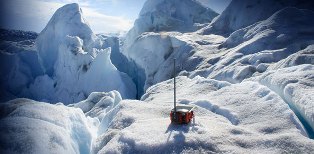
For 55 days, Meredith Nettles and colleagues used GPS sensors and cameras to monitor the Helheim Glacier. They found that the force of calving ice was enough to push back against the glacier.
“It’s like taking a really strong spring, pushing on the front of it and just making it compress,” said Ms. Nettles, a professor of earth science at Columbia University’s Lamont-Doherty Earth Observatory, in an interview with LiveScience. “The glacier moves backward for a few minutes before springing forward again and moving as normal.”
Then the falling ice plummets into the ocean below, displacing a large amount of water. The gap between the iceberg and the glacier floods rapidly, leaving a powerful low-pressure zone in its wake. This movement pulls water up from the ocean floor, exerting significant upward force. The combination of vertical and horizontal pull creates the rumbling effect known as a glacial earthquake.