

Customs Today
  • Home
  • Islamabad
  • Karachi
  • Lahore
  • National
  • Transfers and Postings
  • Chambers & Associations
  • Business
No Result
View All Result
Customs Today
  • Home
  • Islamabad
  • Karachi
  • Lahore
  • National
  • Transfers and Postings
  • Chambers & Associations
  • Business
No Result
View All Result
Customs Today
No Result
View All Result
Home Science & Technology Science

ESA Prefers less explosive approach to asteroid defense

byCustoms Today Report
07/07/2015
in Science, Science & Technology
Share on FacebookShare on Twitter

You might also like

Tesla driverless system to use updated radar technology

12/09/2016

Apple to develop its own self-driving technology

10/09/2016

WASHINGTON: The blockbuster film Armageddon depicted how the Earth was faced with the threat of a direct collision with a giant asteroid from space. The disaster was averted, however, through the efforts of several government agencies that blew up the massive space rock using a nuclear device.
In case of a similar event happening in real life, the National Aeronautics and Space Administration (NASA) and the European Space Agency (ESA) have both devised their own contingency plan to prevent a worldwide catastrophe.
While NASA’s plan adopts elements from the film Armageddon, especially the use of satellites to set off nuclear explosions on asteroids, the ESA’s plan features a gentler strategy of using a device called a kinetic impactor to blast space rocks with projectiles in order to deflect them from Earth.
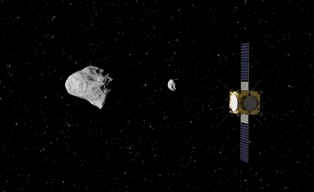
The space agency’s proposal, called Asteroid Impact Mission (AIM), also includes a plan to pull asteroids closer to the planet for prospecting if they are discovered to be rich in minerals.
The ESA’s first target for the AIM is a pair of asteroids known as Didymos, which was spotted by different telescopes from the world.
The main body of the space rock measures at 800 meters (half a mile) in diameter, and it is orbited by a 170-meter (approx. 558 feet) moon named Didymoon. Both objects were at a location favorable for observation by Earth scientists March to June.

Related Stories

Tesla driverless system to use updated radar technology

byCT Report
12/09/2016

WASHINGTON: Electric carmaker Tesla announced Sunday it was upgrading its Autopilot software to use more advanced radar technology. In a...

Apple to develop its own self-driving technology

byCT Report
10/09/2016

SAN FRANCISCO: Apple may not become an automaker, but it still wants to develop its own self-driving technology. The iPhone-maker's...

NASA spots slowest known magnetar

byCT Report
10/09/2016

WASHINGTON: Astronomers have found evidence of a magnetar - magnetised neutron star - that spins much slower than the slowest...

‘YouTubers’ outshining old-school television

byCT Report
09/08/2016

SAN FRANCISCO: A media revolution is taking place, and most people over 35 years of age aren’t tuned in. Millennial...

Next Post

Spiders can sail over the surface of water

  • Terms and Conditions
  • Disclaimer

© 2011 Customs Today -World's first newspaper on customs. Customs Today.

No Result
View All Result
  • Transfers and Postings
  • Latest News
  • Karachi
  • Islamabad
  • Lahore
  • National
  • Chambers & Associations
  • Business
  • About Us

© 2011 Customs Today -World's first newspaper on customs. Customs Today.