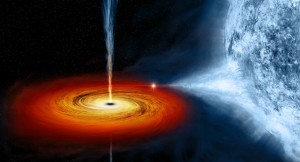


EUROPE: Astronomers have found evidence for a large population of hidden supermassive black holes in the Universe.
Using NASA’s Nuclear Spectroscopic Telescope Array (NuSTAR) satellite observatory, the team of international scientists detected the high-energy x-rays from five supermassive black holes previously clouded from direct view by dust and gas.
The research, led by astronomers at Durham University, UK, supports the theory that potentially millions more supermassive black holes exist in the Universe, but are hidden from view.
The findings were presented today at the Royal Astronomical Society’s National Astronomy Meeting, at Venue Cymru, in Llandudno, Wales (Monday 6 July).
The scientists pointed NuSTAR at nine candidate hidden supermassive black holes that were thought to be extremely active at the centre of galaxies, but where the full extent of this activity was potentially obscured from view.
High-energy x-rays found for five of the black holes confirmed that they had been hidden by dust and gas. The five were much brighter and more active than previously thought as they rapidly feasted on surrounding material and emitted large amounts of radiation.
Such observations were not possible before NuSTAR, which launched in 2012 and is able to detect much higher energy x-rays than previous satellite observatories.
Lead author George Lansbury, a postgraduate student in the Centre for Extragalactic Astronomy, at Durham University, said: “For a long time we have known about supermassive black holes that are not obscured by dust and gas, but we suspected that many more were hidden from our view.

Karachi Port sets 138-year cargo handling record
KARACHI: Pakistan's maritime sector has achieved a major milestone as Karachi Port set a new record in its 138-year history...