

Customs Today
  • Home
  • Islamabad
  • Karachi
  • Lahore
  • National
  • Transfers and Postings
  • Chambers & Associations
  • Business
No Result
View All Result
Customs Today
  • Home
  • Islamabad
  • Karachi
  • Lahore
  • National
  • Transfers and Postings
  • Chambers & Associations
  • Business
No Result
View All Result
Customs Today
No Result
View All Result
Home Science & Technology Science

NASA’s New Horizons finds heart-shaped bright area on the surface of Pluto

byCustoms Today Report
10/07/2015
in Science, Science & Technology
Share on FacebookShare on Twitter

You might also like

Tesla driverless system to use updated radar technology

12/09/2016

Apple to develop its own self-driving technology

10/09/2016

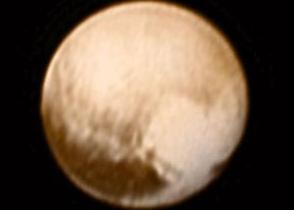
BRENT: NASA’s New Horizons spacecraft has beamed back the most detailed image yet of Pluto, showing a large heart-shaped bright area measuring some 2,000 kilometres across the dwarf planet’s surface.
After more than a nine-year, three-billion-mile journey to Pluto, it is show time for the spacecraft, as the flyby sequence of science observations is officially underway, Nasa said.
Yesterday, mission scientists received the most detailed image yet returned by the Long Range Reconnaissance Imager (LORRI) aboard New Horizons. The image was taken on 7 July, when the spacecraft was just under 8 million kilometres from Pluto, and is the first to be received since the 4 July anomaly that sent the spacecraft into safe mode.
The view is centred roughly on the area that will be seen close-up during New Horizons’ 14 July closest approach. This side of Pluto is dominated by three broad regions of varying brightness.
Most prominent are an elongated dark feature at the equator, informally known as “the whale,” and a large heart-shaped bright area measuring some 2,000 kilometres across on the right. Above those features in the image is a polar region that is intermediate in brightness.
“The next time we see this part of Pluto at closest approach, a portion of this region will be imaged at about 500 times better resolution than we see today,” said Jeff Moore, Geology, Geophysics and Imaging Team Leader of Nasa’s Ames Research Centre.

Related Stories

Tesla driverless system to use updated radar technology

byCT Report
12/09/2016

WASHINGTON: Electric carmaker Tesla announced Sunday it was upgrading its Autopilot software to use more advanced radar technology. In a...

Apple to develop its own self-driving technology

byCT Report
10/09/2016

SAN FRANCISCO: Apple may not become an automaker, but it still wants to develop its own self-driving technology. The iPhone-maker's...

NASA spots slowest known magnetar

byCT Report
10/09/2016

WASHINGTON: Astronomers have found evidence of a magnetar - magnetised neutron star - that spins much slower than the slowest...

‘YouTubers’ outshining old-school television

byCT Report
09/08/2016

SAN FRANCISCO: A media revolution is taking place, and most people over 35 years of age aren’t tuned in. Millennial...

Next Post

Tokyo stocks close 0.38pc lower, Nikkei 225 dips 75.67pts

  • Terms and Conditions
  • Disclaimer

© 2011 Customs Today -World's first newspaper on customs. Customs Today.

No Result
View All Result
  • Transfers and Postings
  • Latest News
  • Karachi
  • Islamabad
  • Lahore
  • National
  • Chambers & Associations
  • Business
  • About Us

© 2011 Customs Today -World's first newspaper on customs. Customs Today.