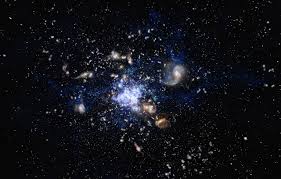


MEXICO: A team of international astronomers has observed for the first time how galaxies were formed in the early days of the universe in Chile, thanks to the ALMA telescope of the European Southern Observatory (ESO).
ALMA, the largest telescope array in the world, had been focusing on detecting the earliest galaxies emerging after the Big Bang, of which little was known until now.
According to ESO, the astronomers led by Roberto Maiolinio, from the University of Cambridge, changed their approach by not looking for the light from stars but focusing on the faint glow of ionized carbon, emitted from gas clouds within which stars form.
This allowed the astronomers to study the relation between newly created stars and the clumps that would go on to become the first galaxies.
“This is the most distant detection ever of this kind of emission from a normal galaxy, seen less than 1 billion years after the Big Bang. It gives us the opportunity to watch the build-up of the first galaxies,” said Andrea Ferrara, co-author of an article about the discovery published in Monthly Notices of the Royal Astronomical Society.

Karachi Port sets 138-year cargo handling record
KARACHI: Pakistan's maritime sector has achieved a major milestone as Karachi Port set a new record in its 138-year history...