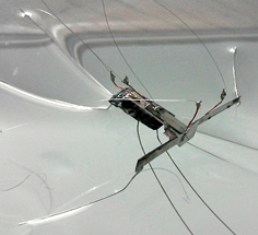


FRANCE: Water striders are probably one of the most fascinating insects for their ability to ‘walk’ on water and taking a cue from them, an international team of researchers has developed a robot that can jump off water’s surface.
Scientists from Seoul National University, Korea (SNU), Harvard’s Wyss Institute for Biologically Inspired Engineering, and the Harvard John A. Paulson School of Engineering and Applied Sciences found out the reason why water striders can not only skim but also generate enough upward thrust with their legs to launch themselves airborne from it.
The key, researchers say, is their legs with slightly curved tips as well as the method of applying force to generate the necessary upward thrust. By studying water striders in comparison to iterative prototypes of their robotic insect, the SNU and Harvard team discovered that the best way to jump off of water is to maintain leg contact on the water for as long as possible during the jump motion.
“If you apply as much force as quickly as possible on water, the limbs will break through the surface and you won’t get anywhere,” said Robert Wood, Ph.D., who is a co-author on the study, a Wyss Institute Core Faculty member, the Charles River Professor of Engineering and Applied Sciences at the Harvard Paulson School, and founder of the Harvard Microrobotics Lab.
“Using its legs to push down on water, the natural water strider exerts the maximum amount of force just below the threshold that would break the water’s surface,” said the study’s co-first author Je-Sung Koh, Ph.D., who was pursuing his doctoral degree at SNU during the majority of this research and is now a Postdoctoral Fellow at the Wyss Institute and the Harvard Paulson School.

Karachi Port sets 138-year cargo handling record
KARACHI: Pakistan's maritime sector has achieved a major milestone as Karachi Port set a new record in its 138-year history...