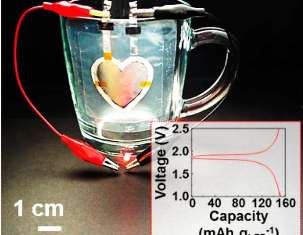


MEXICO: Scientists have developed a new technique that can print batteries on almost any surface, which is expected to be essential for future flexible electronics such as roll-up displays, smart electronic clothing, and Google Glass-type devices. Whereas today’s Li-ion batteries can be fabricated only in fixed shapes and sizes, such as cylinders or pouch cells, the new Li-ion batteries can be printed in their entirety—including electrodes and electrolyte—almost anywhere. The researchers even predict that in the future the batteries could be printed with a 3D printer into various 3D shapes.
The researchers, led by Sang-Young Lee, Professor at the Ulsan National Institute of Science and Technology (UNIST) in South Korea, have published a paper on the new printable solid-state (PRISS) Li-ion batteries in a recent issue of Nano Letters.
In conventional Li-ion battery manufacturing, the electrodes and separator membranes are stacked or wound around each other and packaged into metallic cases, which are then injected with liquid electrolytes. It’s been difficult to fabricate batteries in diverse shapes and sizes due to the fact that the liquid electrolytes are combustible and may leak if not packaged well, and also because the separator membranes are necessary for preventing contact between the electrodes.
The new battery manufacturing method does not require either liquid-electrolyte injection or separator membranes. Instead, the electrolyte is made of a paste, the electrodes are made of a slurry, and they are consecutively printed onto a surface and then cured with ultraviolet light. Because the electrolyte paste is printed in between the electrodes, it also plays the role of the separator membrane. The slurry and paste can also be printed through a stencil, allowing for batteries to be printed in different shapes, letters, and designs.

Karachi Port sets 138-year cargo handling record
KARACHI: Pakistan's maritime sector has achieved a major milestone as Karachi Port set a new record in its 138-year history...