

Customs Today
  • Home
  • Islamabad
  • Karachi
  • Lahore
  • National
  • Transfers and Postings
  • Chambers & Associations
  • Business
No Result
View All Result
Customs Today
  • Home
  • Islamabad
  • Karachi
  • Lahore
  • National
  • Transfers and Postings
  • Chambers & Associations
  • Business
No Result
View All Result
Customs Today
No Result
View All Result
Home Science & Technology Science

Copper cluster catalyst effective for low-pressure conversion of CO2

byCustoms Today Report
10/08/2015
in Science, Science & Technology
Share on FacebookShare on Twitter

You might also like

Tesla driverless system to use updated radar technology

12/09/2016

Apple to develop its own self-driving technology

10/09/2016

CANADA: Capture and convert—this is the motto of carbon dioxide reduction, a process that stops the greenhouse gas before it escapes from chimneys and power plants into the atmosphere and instead turns it into a useful product.
One possible end product is methanol, a liquid fuel and the focus of a recent study conducted at the U.S. Department of Energy’s (DOE) Argonne National Laboratory. The chemical reactions that make methanol from carbon dioxide rely on a catalyst to speed up the conversion, and Argonne scientists identified a new material that could fill this role. With its unique structure, this catalyst can capture and convert carbon dioxide in a way that ultimately saves energy.
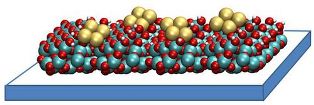
They call it a copper tetramer.
It consists of small clusters of four copper atoms each, supported on a thin film of aluminum oxide. These catalysts work by binding to carbon dioxide molecules, orienting them in a way that is ideal for chemical reactions. The structure of the copper tetramer is such that most of its binding sites are open, which means it can attach more strongly to carbon dioxide and can better accelerate the conversion.
The current industrial process to reduce carbon dioxide to methanol uses a catalyst of copper, zinc oxide and aluminum oxide. A number of its binding sites are occupied merely in holding the compound together, which limits how many atoms can catch and hold carbon dioxide.

Related Stories

Tesla driverless system to use updated radar technology

byCT Report
12/09/2016

WASHINGTON: Electric carmaker Tesla announced Sunday it was upgrading its Autopilot software to use more advanced radar technology. In a...

Apple to develop its own self-driving technology

byCT Report
10/09/2016

SAN FRANCISCO: Apple may not become an automaker, but it still wants to develop its own self-driving technology. The iPhone-maker's...

NASA spots slowest known magnetar

byCT Report
10/09/2016

WASHINGTON: Astronomers have found evidence of a magnetar - magnetised neutron star - that spins much slower than the slowest...

‘YouTubers’ outshining old-school television

byCT Report
09/08/2016

SAN FRANCISCO: A media revolution is taking place, and most people over 35 years of age aren’t tuned in. Millennial...

Next Post

Chile's Large Telescope captured glowing 'ghost of a star'

  • Terms and Conditions
  • Disclaimer

© 2011 Customs Today -World's first newspaper on customs. Customs Today.

No Result
View All Result
  • Transfers and Postings
  • Latest News
  • Karachi
  • Islamabad
  • Lahore
  • National
  • Chambers & Associations
  • Business
  • About Us

© 2011 Customs Today -World's first newspaper on customs. Customs Today.