
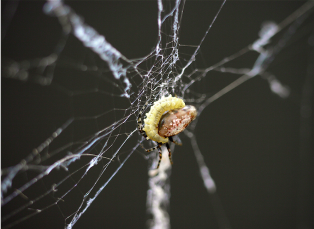


HARROW: Like a mindless zombie controlled by a menacing overlord, the spider scampers back and forth, reinforcing its silky web. Not long from now, the subservient arachnid will be dead, its web transformed into a shelter for the spawn of the creature that once controlled it, according to a new study.
No, this isn’t science fiction; it’s the somewhat terrifying (but very real) tale of the orb-weaving spider Cyclosa argenteoalba and the parasitic wasp Reclinervellus nielseni, two species that carry out a strange relationship in Hyogo prefecture, Japan.
Together, the wasp and the spider provide a perfect example of host manipulation — an ecological process in which one species (the parasite) and its young (the parasitoids) manipulate the behaviors of another species (the host) to their advantage.
The manipulative relationship between the wasp and the spider begins when a female wasp attacks the orb weaver in its web. She deposits her egg onto the back of the spider’s abdomen but doesn’t kill it. Firmly attached to the spider, the egg develops into a larva, which eventually does kill its host, but not before the spider serves it as a slave throughout the early stages of development, said Keizo Takasuka, a postdoctoral fellow at Kobe University’s Graduate School of Agricultural Science in Japan.

Karachi Port sets 138-year cargo handling record
KARACHI: Pakistan's maritime sector has achieved a major milestone as Karachi Port set a new record in its 138-year history...


