Customs Today
  • Home
  • Islamabad
  • Karachi
  • Lahore
  • National
  • Transfers and Postings
  • Chambers & Associations
  • Business
No Result
View All Result
Customs Today
  • Home
  • Islamabad
  • Karachi
  • Lahore
  • National
  • Transfers and Postings
  • Chambers & Associations
  • Business
No Result
View All Result
Customs Today
No Result
View All Result
Home Science & Technology Science

Scientists used 142 teeth to identify six non-avian dinosaurs

byCustoms Today Report
12/08/2015
in Science, Science & Technology
Share on FacebookShare on Twitter

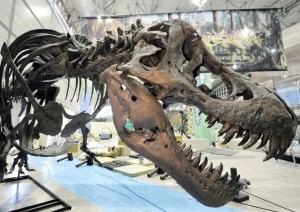
MEXICO: Scientists have used 142 teeth to identify six non-avian dinosaurs of the Upper Cretaceous period that existed in the South Pyrenees Basin in Spain.

Researchers examined one of the smallest parts of the fossil record – theropod teeth – to shed light on the evolution of dinosaurs at the end of the Cretaceous period.


You might also like

Tesla driverless system to use updated radar technology

12/09/2016

Apple to develop its own self-driving technology

10/09/2016

Findings have effectively quadrupled the dinosaur diversity in the Campanian-Maastrichtian of the South Pyrenean Basin in Spain. There were previously only two known species in the area, researchers said.

The study of 142 isolated teeth from the area suggests six additional species of toothed theropods (five small, one large) were present in the region.

“Studying these small parts helps us reconstruct the ancient world where dinosaurs lived and to understand how their extinction happened,” said lead author Angelica Torices, post-doctoral fellow in biological sciences at the University of Alberta.

“Teeth are especially important in the study of Upper Cretaceous creatures in Spain and the rest of Europe because we don’t have complete skeletons of theropods from that time in those locations,” Torices said.

“We have to rely on these small elements to reconstruct the evolution of these dinosaurs, particularly the theropods,” she said.

Carnivorous dinosaurs replaced their teeth continuously, with just one dinosaur producing a huge number of these dental pieces and an endless number of clues for understanding these mysterious creatures.

This study demonstrates the value of isolated teeth in reconstructing the composition of dinosaur paleofaunas when other, more complete material is not present, allowing interpretation of the evolution of diversity through time.


Related Stories

Tesla driverless system to use updated radar technology

byCT Report
12/09/2016

WASHINGTON: Electric carmaker Tesla announced Sunday it was upgrading its Autopilot software to use more advanced radar technology. In a...

Apple to develop its own self-driving technology

byCT Report
10/09/2016

SAN FRANCISCO: Apple may not become an automaker, but it still wants to develop its own self-driving technology. The iPhone-maker's...

NASA spots slowest known magnetar

byCT Report
10/09/2016

WASHINGTON: Astronomers have found evidence of a magnetar - magnetised neutron star - that spins much slower than the slowest...

‘YouTubers’ outshining old-school television

byCT Report
09/08/2016

SAN FRANCISCO: A media revolution is taking place, and most people over 35 years of age aren’t tuned in. Millennial...

Next Post

New study shows eye geometry could offer more information about evolution

  • Terms and Conditions
  • Disclaimer

© 2011 Customs Today -World's first newspaper on customs. Customs Today.

No Result
View All Result
  • Transfers and Postings
  • Latest News
  • Karachi
  • Islamabad
  • Lahore
  • National
  • Chambers & Associations
  • Business
  • About Us

© 2011 Customs Today -World's first newspaper on customs. Customs Today.