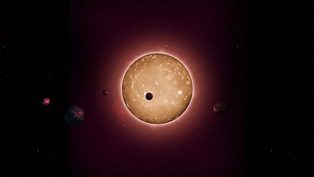
WASHINGTON: Astronomers have found a new “Star Wars-like” planet orbiting in the “habitable zone” of two stars, the 10th such exoplanet located by Nasa’s Kepler Mission.
The planet is known as Kepler-453b. The “habitable zone” is the area around stars in which life could potentially exist. And the somewhat fortuitous nature of Kepler-453b’s discovery indicates there could be more like it than previously believed, according to Stephen Kane, an assistant professor of physics and astronomy at San Francisco State University and member of the team that made the discovery.
“If we had observed this planet earlier or later than we did, we would have seen nothing and assumed there was no planet there,” Kane said.
You might also like


“That suggests that there are a lot more of these kinds of planets than we are thinking, and we’re just looking at the wrong time,” he said.
Researchers typically detect “exoplanets” — planets outside our solar system — by observing the decrease in starlight as the planet passes, or “transits”, between its host star and Earth. This method is known as the “transit method”. But because Kepler-453b is affected by the gravitational pull of two stars, not just one, its orbit is more erratic — “like a spinning top”, said Kane. In fact, had researches not detected the planet now, their next chance to do so would not have come until 2066.