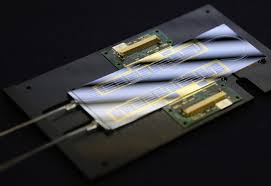
LONDON: Researchers from the University of Bristol in the UK and Nippon Telegraph and Telephone (NTT) in Japan have developed an optical chip that “can process photons in an infinite number of ways”. Thanks to this capability it is a possible contender to replace the general purpose computer microprocessors we use today in our PCs. Due to the possibilities opened up by quantum computing, such chips could complete tasks and solve problems that are beyond the scope of application of today’s most powerful supercomputers.
A University of Bristol press release says that its fully reprogrammable chip brings together previous quantum experiments and will be able to “realise a plethora of future protocols that have not even been conceived yet”. The chip design will facilitate quick and easy testing of quantum science theories and quantum computing experiments.
You might also like


Project leader Dr Anthony Laing explained “A whole field of research has essentially been put onto a single optical chip that is easily controlled. The implications of the work go beyond the huge resource savings. Now anybody can run their own experiments with photons, much like they operate any other piece of software on a computer. They no longer need to convince a physicist to devote many months of their life to painstakingly build and conduct a new experiment.” This ability was demonstrated by the research team as reportedly they “carried out a year’s worth of experiments in a matter of hours”.