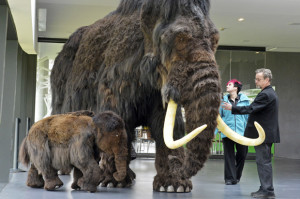
NEW YORK: The research team published their findings in the scientific journal Ecography, findings which indicate that, unfortunately, when a species extinction coincided with a human encounter, humans were likely the reason that species went extinct when it did.
Climate change may also have contributed by limiting habitats and destroying niches, the study suggests, but the fact that the die-outs just happened to occur whenever humans showed up is no coincidence.
You might also like


Two recent studies into ancient animal extinction appear to diametrically contradict each other, after a new university study claimed it was humans, and not climate change, that caused the demise of mammoths, sabretooth tigers and other ancient species, according to the Russian Federation Today channel.
As per Lewis Bartlett, a researcher from the University of Exeter’s Centre for Ecology and Conservation, their results are nearly like the “nail in the coffin of this 50-year debate”.
The animals, known collectively as megafauna, were wiped out over the last 80,000 years.
“…humans were the dominant cause of the extinction of megafauna”, said Bartlett.
By using cutting-edge statistical analysis, researchers said they ran thousands of scenarios which mapped the windows of time in which each species was known to have become extinct, and humans were known to have arrived on different continents or islands.
What we don’t know is what it was about these early settlers that caused this demise. These results were compared against climate reconstructions for the last 90,000 years. Nonetheless, the study has shown that more than climate change, human colonization caused the extinction, refuting the myth that humans have always lived peacefully with nature. The researchers noted they did find some instances (mostly in Asia) in which the patterns were largely unaccounted for by either extinction factor, highlighting the need for more research to be done on these regions. “Understanding why megafauna in mainland Asia is so resilient is the next big question”, says Dr. Andrea Manica, lead supervisor of the study from the Cambridge University.
Researchers said that they will now look into why the megafauna continued to exist for so long in Asia, where they suffered very low rates of extinction.