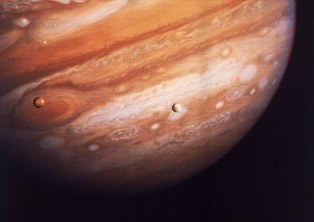


WASHINGTON: Researchers say it’s possible the solar system’s biggest planets, the mighty gas giants Jupiter and Saturn, started slowly from the most humble of ingredients: tiny pebbles.
By “pebbles,” they mean anything from fractions of an inch up to three feet across, still “pebbles” in the cosmic scheme of things.
Most current theories of how the large gas giant planets formed assume the cores of the solar system’s largest worlds formed from collisions between much larger objects, 10 or even hundreds of kilometers in diameter.
However, if that were the case, the cores would not have formed quickly enough to capture gases in the early solar system that constitute their atmospheres today, a new study by scientists at Queen’s University in Canada and the Southwest Research Institute in Texas suggests.
Previous studies have suggested the gas disks that planets first begin to form from usually last for only one to 10 million years, whereas rocky planets like Earth took a minimum of 30 million years, and possibly a maximum of 100 million years, to form from the slow accretion of larger material available later in the solar system’s evolution.

Karachi Port sets 138-year cargo handling record
KARACHI: Pakistan's maritime sector has achieved a major milestone as Karachi Port set a new record in its 138-year history...