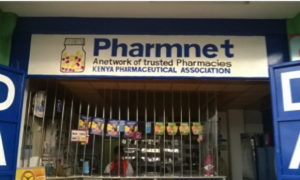
NAIROBI: The distinctive blue and white facades of Pharmnet-branded pharmacies in Kahawa West, located on the outskirts of Nairobi, are fast becoming beacons of quality assurance for surrounding communities.
It is here that Pharmnet is piloting its marketing strategy and innovative group purchasing business model – developed with technical assistance from the Private Sector Innovation Programme for Health (PSP4H). With 100 pharmacies already branded in Nairobi and Mombasa, and a further 250 to be branded in other counties over the next quarter, Pharmnet officially launched on 20 August, 2015 at the Crowne Plaza in Nairobi.


Pharmacies are the first point of contact for the majority of Kenyans seeking healthcare. Yet according to research by PSP4H, only 4,000 of the 12,000 pharmacies in Kenya are licensed with the Pharmacy and Poisons Board. This means that consumers cannot be confident in the quality, authenticity or value of the medicines they purchase.
According to PSP4H, Kenya’s “mass market” for healthcare – 22 million people or 50% of the population – earn between KSh500 and KSh1000 a day, leaving them particularly vulnerable when illness strikes.
With little disposable income (between 60p and £2 per day), this low-income group is forced to pay out-of-pocket for healthcare and suffers the “poverty penalty”: the need to pay multiple times for healthcare since initial care from informal operators does not properly treat illnesses. The launch of Pharmnet could not have come soon enough for Kenya’s mass market.
Funded by the UK government’s Department for International Development (DFID), PSP4H is an action research programme designed to improve the for-profit health market in Kenya so that low-income communities can get better value for money on healthcare spending. Pharmnet meets the key criteria of PSP4H’s market systems approach to development.
Working with existing initiatives and partner organisations, the Kenya Pharmaceutical Association (KPA), with a membership of 7,000, ensures that interventions can be scaled up sustainably.
The Pharmnet concept was already being pursued by KPA, yet it lacked the capacity for implementation. PSP4H has therefore taken on a facilitation role, providing technical assistance to develop training, quality assurance systems, the Pharmnet brand, a marketing and communication strategy, a pooled procurement business model administered by KPA’s subsidiary Nairobi Tech Pharm and business skills training for its members (through links with other PSP4H interventions). The result is that KPA members now have the capacity to launch and implement the Pharmnet network.
As Mr. Elo Mapelu, senior member of KPA and chairman of Nairobi TechPharm has stated “PSP4H has given us the technical support to develop Pharmnet as a commercial retail chain of pharmacies … we [members of KPA] are not trained in business but they have helped bridge this gap”.
This market-systems approach is aligned with core principles of the Business Call to Action, a partnership hosted by the United Nations Development Programme, which challenges companies to develop inclusive business models delivering commercial success along with development impact and inclusive growth for low-income communities. In December 2014, PSP4H and BCtA co-hosted a forum in Nairobi focused on exploring innovative market-driven approaches to healthcare delivery for low-income Kenyans.