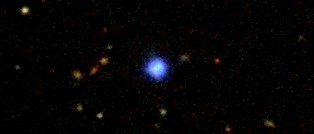
LONDON: Some dying stars suffer from ‘irregular heartbeats’, research led by astronomers at the University of Warwick has discovered.
The research confirms rapid brightening events in otherwise normal pulsating white dwarfs, which are stars in the final stage of their life cycles.


In addition to the regular rhythm from pulsations they expected on the white dwarf PG1149+057, which cause the star to get a few percent brighter and fainter every few minutes, the researchers also observed something completely unexpected every few days: arrhythmic, massive outbursts, which broke the star’s regular pulse and significantly heated up its surface for many hours.
The discovery was made possible by using the planet-hunting spacecraft Kepler, which stares unblinkingly at a small patch of sky, uninterrupted by clouds or sunrises.
Led by Dr JJ Hermes of the University of Warwick’s Astrophysics Group, the astronomers targeted the Kepler spacecraft on a specific star in the constellation Virgo, PG1149+057, which is roughly 120 light years from Earth.
Dr Hermes explains: “We have essentially found rogue waves in a pulsating star, akin to ‘irregular heartbeats’. These were truly a surprise to see: we have been watching pulsating white dwarfs for more than 50 years now from the ground, and only by being able to stare uninterrupted for months from space have we been able to catch these events.”
The star with the irregular beat, PG1149+057, is a pulsating white dwarf, which is the burnt-out core of an evolved star, an extremely dense star which is almost entirely made up of carbon and oxygen. Our Sun will eventually become a white dwarf in more than six billion years, after it runs out of its nuclear fuel.
White dwarfs have been known to pulsate for decades, and some are exceptional clocks, with pulsations that have kept nearly perfect time for more than 40 years. Pulsations are believed to be a naturally occurring stage when a white dwarf reaches the right temperature to generate a mix of partially ionized hydrogen atoms at its surface.