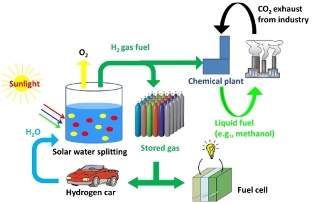


PARIS: Researchers at Michigan Technological University have mimicked the process of photosynthesis to produce hydrogen fuel using water and light and that too with high efficiency.
In a study published in the Journal of Physical Chemistry, researchers Yun Hang Hu, the Charles and Carroll McArthur professor of Materials Science and Engineer, and his PhD student, Bing Han, at Michigan Tech have described their process.
In this new hydrogen production process, the key is the interactions of a catalyst, light and a sacrificial molecule.
Researchers liken the process to a complex sports game being played by black titanium dioxide, methanol and light to split water to produce hydrogen molecules. From the looks of it the process looks simple as production of hydrogen molecules involves moving an electron from one place to another, like kicking a football to get a field goal.
To make that score, a water molecule captures an electron excited within a material. When excited, electrons move up and down in different bands; the lower one here is the valence band and the higher one is the conduction band. The valence band and the conduction band are like goal posts, and between them is the band gap, which is like the playing field. The excited electron is the ball being passed around.
Solar energy, with both ultraviolet (UV) and visible light energy, is what gets this ball rolling. Light energy bounces off the first player, titanium dioxide, which is the material where the valence band and conduction band are in play. That excites an electron, making it a photo-excited charge that shoots up towards the conduction band. For UV light, the playing field is pretty big, and the band gap stretches 3.2 electron volts wide.
Here’s where the game gets more complicated, Harry Potter Quidditch-style, with balls that move quickly on their own. Electrons tend to zip like a golden snitch, and they sometimes misbehave, scurrying back to their starting place in the valence band, which negates the goal score and H2 production.

Karachi Port sets 138-year cargo handling record
KARACHI: Pakistan's maritime sector has achieved a major milestone as Karachi Port set a new record in its 138-year history...