

Customs Today
  • Home
  • Islamabad
  • Karachi
  • Lahore
  • National
  • Transfers and Postings
  • Chambers & Associations
  • Business
No Result
View All Result
Customs Today
  • Home
  • Islamabad
  • Karachi
  • Lahore
  • National
  • Transfers and Postings
  • Chambers & Associations
  • Business
No Result
View All Result
Customs Today
No Result
View All Result
Home Science & Technology Science

NASA’s Hubble captured stunning, cosmic phenomena

byCustoms Today Report
28/08/2015
in Science, Science & Technology
Share on FacebookShare on Twitter

You might also like

Tesla driverless system to use updated radar technology

12/09/2016

Apple to develop its own self-driving technology

10/09/2016

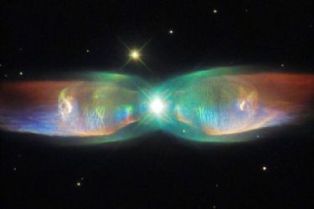
HONG KONG: NASA’s Hubble Space Telescope was able to capture a rare, and stunning, cosmic phenomena that has been named the “cosmic butterfly.”
The Twin Jet Nebula is full of awe-inspiring colors and complexities, two shining lobes of material flowing away from a binary star system, mesmerizing all onlookers. The pair of lobes are two massive jets of gas streaming off from the star system, with the striking view caused by the gas that is moving at one million kilometers per hour.
The Twin Jet Nebula, officially called the PN M2-9, is named PN because the nebula is designated as a planetary nebula and M which refers to the person who discovered it: Rudolf Minkowski, according to the Hullabaloo Online.
The smaller of the two stars that make up the nebula ranges from 0.6 to 1.0 solar masses and is a small white dwarf, which is the final stage of a star of this size and the larger of the two stars ranges from 1.0 to 1.4 solar masses is right behind it and is the one responsible for the cosmic lights it gives off that was captured by the Hubble. To put the size in perspective, the sun is 1.0 solar masses.
In the image, the two jets are headed in opposite directions because the gravitational interactions between the two star. The stars take about 100 years to circle each other, giving off a light show that is extremely rare and may not be seen again in our current generation.

Related Stories

Tesla driverless system to use updated radar technology

byCT Report
12/09/2016

WASHINGTON: Electric carmaker Tesla announced Sunday it was upgrading its Autopilot software to use more advanced radar technology. In a...

Apple to develop its own self-driving technology

byCT Report
10/09/2016

SAN FRANCISCO: Apple may not become an automaker, but it still wants to develop its own self-driving technology. The iPhone-maker's...

NASA spots slowest known magnetar

byCT Report
10/09/2016

WASHINGTON: Astronomers have found evidence of a magnetar - magnetised neutron star - that spins much slower than the slowest...

‘YouTubers’ outshining old-school television

byCT Report
09/08/2016

SAN FRANCISCO: A media revolution is taking place, and most people over 35 years of age aren’t tuned in. Millennial...

Next Post

Shahbaz ‘again’ blames PTI sit-in for halt in Chinese investment

  • Terms and Conditions
  • Disclaimer

© 2011 Customs Today -World's first newspaper on customs. Customs Today.

No Result
View All Result
  • Transfers and Postings
  • Latest News
  • Karachi
  • Islamabad
  • Lahore
  • National
  • Chambers & Associations
  • Business
  • About Us

© 2011 Customs Today -World's first newspaper on customs. Customs Today.