
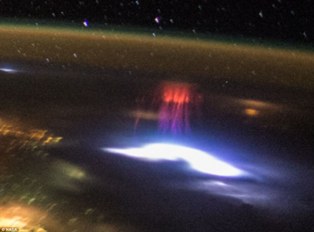


LONDON: Mysterious red flashes seen high above the Earth are a little understood phenomenon known as sprites.
The sprites, which appear as red dots in the top left hand corner, were photographed above a thunderstorm by the crew of the International Space Station as it flew over north-western Mexico.
As the astronauts looked towards the north-east, they saw the blue-white lightning of a powerful thunderstorm and sudden ephemeral flashes of red sprites lighting up the night sky high over Missouri and Illinois some 2200 kilometres away.
The lights of Dallas, are near the centre of our image, with Houston is on the upper right.
The green band visible above the horizon and below the Moon, is airglow, a faint emission of ionised light in the atmosphere.
Apart from occasional reports of strange lights seen above thunderstorms by airline pilots, almost nothing was known about sprites, blue jets and elves, until a couple of decades ago when scientists studying thunderstorms began picking them up in photographs.
Sprites are transient vertical column-like plasma structures, flashing high in the Earth’s atmosphere, often in reddish clusters at altitudes of 50 to 90 kilometres.
Scientists think sprites are large-scale electrical discharges triggered by a rare type of lightning called ‘positive lightning’ that originates in the anvil head of a thundercloud where positive charges tend to accumulate.
Positive lightning is about five times as powerful and hot as the main type of lightning we see on Earth known as ‘negative lightning’. It also last about 10 times longer, allowing it to strike many kilometres away from the storm and leading to the expression “a bolt out of the blue”.
Unlike negative lightning, which occurs either inside a cloud or from the base of a cloud to the ground, positive lightning travels outside the cloud, striking the ground directly.

Karachi Port sets 138-year cargo handling record
KARACHI: Pakistan's maritime sector has achieved a major milestone as Karachi Port set a new record in its 138-year history...


