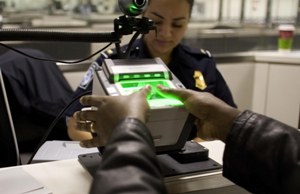
NEW YORK: US Customs and Border Protection is set to launch a biometric border entry and exit control pilot program at Otay Mesa, San Diego in an effort to identify and apprehend foreigners with expired visas who are have surpassed their permitted duration.
The “Pedestrian Border Experiment,” which will likely launch this year, will target non-U.S. citizens who enter and exit the country on foot through Otay Mesa.


The pilot program will be the agency’s first use of facial and iris scans on the nation’s southern border, said U.S. Customs and Border Protection.
The biometrics program is intended to track nonimmigrant visa holders who enter the country legally but continue to stay in the country after their visa has expired.
“We want some system to determine that you’ve left the country, whether it’s at an airport getting onto the jetway, or here at the pedestrian crossing,” said R. Gil Kerlikowske, the federal agency’s commissioner, during a visit to San Diego this month.
The CBP currently performs southbound checks at the Mexican border, however, these checks are typically conducted to search vehicles for weapons, bulk cash and other contraband.
As a result, those pedestrians walking into Mexico at Otay Mesa are usually not thoroughly checked by both the U.S. and Mexican governments.
The pilot will take place over a two months and is expected to involve a significant number of pedestrians, with CBP estimating that there were about 183,000 northbound pedestrians at Otay Mesa in June, or more than 6,000 a day.
The number of people crossing the border southbound is estimated to be about the same, although there is no official count.
The pilot program continues the federal government’s growing use of biometrics, which has become a hot button issue among privacy advocates.
The CBP said that its biometrics testing “is dedicated to protecting the privacy of all travelers,” and that “the images will be stored in a secured local database and will be used for test purposes only and will not be stored or shared with any other party or system.”
James Wayman, a biometrics expert at San Jose State University, said that facial and iris recognition methods “can be sensitive to lighting conditions and human factors, such as hats, glasses and contact lenses,” adding that the Otay Mesa trial “will determine if the available technical options for automated passenger recognition can be expanded to include iris and face imaging.”
During the pilot, CBP will use kiosks to capture the iris and facial biometric readings of northbound foreign pedestrians at Otay Mesa, said Pete Flores, director of the CBP’s San Diego field office. Meanwhile, border procedures for U.S. citizens will remain unchanged.