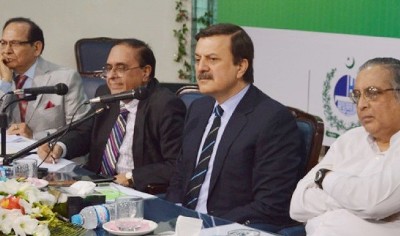
ISLAMABAD: The Institute for Policy Reforms (IPR) and the Higher Education Commission (HEC) have jointly organised a seminar under the title of ‘Building a Knowledge Economy: Imperative for Socio-Economic Development’.
Addressing at the occasion, IPR Chairman Humayun Akhtar Khan has said that reliance on science and technology will place Pakistan’s economy on a path of sustained development. He stressed on the need to strengthen science & technology as this was the critical need of the time. He stated that value addition and knowledge input were key components for economic activity and were important determinants for growth.

He said that joint effort on the part of government, academia, and the private sector would help achieve this objective. “We live in a world where knowledge has become the most important factor that determines socio-economic development while natural resources have diminishing importance.
Dr Atta Ur Rahman, Adviser IPR and former federal minister and Chairperson Higher Education Commission, addressing on the occasion, said that Pakistan cannot progress without focusing on the “triple helix” of the knowledge economy – technology driven government policies, strong universities/research centres, and the critically important role of private sector in undertaking the manufacture and export of high technology products.
Prof Atta-ur-Rahman called for a departure from anarchaic development model that focused almost entirely on natural resources and production of low value agricultural and industrial products to an export oriented stance involving manufacture and exports of high value added goods. It was time to move towards building a strong knowledge economy. He dwelled on three key pillars for socio-economic development of the country.
Pakistan, he said, was into the low value added textile sector in its manufacturing and exports whereas the big money could only be earned in the manufacture and exports of high value added agricultural products, chemicals, pharmaceuticals, biotechnology goods, IT products and services, automobiles, ships, household appliances industrial machinery, and defence products.
He noted that while developed countries had about 3,000 scientists per million population, Pakistan had only a couple of hundred per million. He said that government must target to produce about 500,000 new scientists and engineers in the next ten years and put them to good use.