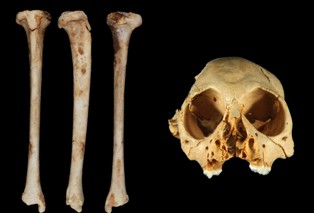


LONDON: The fossilized remains of a monkey has been recovered in an underwater cave in the Altagracia Province of the Dominican Republic. The monkey remains have finally been determined to be roughly one million years old, and likely belonged to the long extinct Antillothrix bernensis species.
The first bone found was a tibia (leg bone) embedded in limestone rock. The research team—led by Dr. Helen Green, of the Melbourne University School of Earth Sciences—used the Uranium-series technique to date the rocks.
Dr. Helen Green comments “The presence of endemic new world monkeys on the Caribbean islands is one the great questions of bio-geography and our work on these fossils shows Antillothrix existed on Hispaniola relatively morphologically unchanged for over a million years. By establishing the age of these fossils we have changed the understanding of primate evolution in this region.”
In addition, study co-authors Prof. Alfred Rosenberger and Dr Siobhán Cooke had already been working at this site since 2009. There focus, of course, was to find rare fossil remains of endemic mammals. Of course, they have definitely succeeded in this case. And, of course, this discovery will now allow them to investigate how these particular animals were able to adapt to the island environments.
Dr. Cooke goes on to say, “Very little was known about the native monkey from this island [and] prior to our discoveries in Altagracia we knew almost nothing even though this species was first described by Renato Rímoli back in 1977.”

Karachi Port sets 138-year cargo handling record
KARACHI: Pakistan's maritime sector has achieved a major milestone as Karachi Port set a new record in its 138-year history...