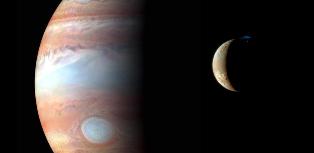
PERTH: Tides flowing in a subsurface ocean of molten rock, or magma, could explain why Jupiter’s moon Io appears to have its volcanoes in the “wrong” place. New NASA research implies that oceans beneath the crusts of tidally stressed moons may be more common and last longer than expected. The phenomenon applies to oceans made from either magma or water, potentially increasing the odds for life elsewhere in the universe.
“This is the first time the amount and distribution of heat produced by fluid tides in a subterranean magma ocean on Io has been studied in detail,” said Robert Tyler of the University of Maryland, College Park and NASA’s Goddard Space Flight Center in Greenbelt, Maryland. “We found that the pattern of tidal heating predicted by our fluid-tide model is able to produce the surface heat patterns that are actually observed on Io.” Tyler is lead author of a paper on this research published June 2015 in the Astrophysical Journal Supplement Series.
Io is the most volcanically active world in the solar system, with hundreds of erupting volcanoes blasting fountains of lava up to 250 miles (about 400 kilometers) high. The intense geological activity is the result of heat produced by a gravitational tug-of-war between Jupiter’s massive gravity and other smaller but precisely timed pulls from Europa, a neighboring moon to Io that orbits further from Jupiter. Io orbits faster, completing two orbits every time Europa finishes one. This regular timing means that Io feels the strongest gravitational pull from its neighbor in the same orbital location, which distorts Io’s orbit into an oval shape. This modified orbit causes Io to flex as it moves around Jupiter, causing material within Io to shift position and generate heat by friction, just as rubbing your hands together briskly makes them warmer.