
Customs Today
  • Home
  • Islamabad
  • Karachi
  • Lahore
  • National
  • Transfers and Postings
  • Chambers & Associations
  • Business
No Result
View All Result
Customs Today
  • Home
  • Islamabad
  • Karachi
  • Lahore
  • National
  • Transfers and Postings
  • Chambers & Associations
  • Business
No Result
View All Result
Customs Today
No Result
View All Result
Home Science & Technology Science

Cancer patient successfully receives 3D printed ribs in world’s 1st such surgery

byCustoms Today Report
12/09/2015
in Science, Science & Technology
Share on FacebookShare on Twitter

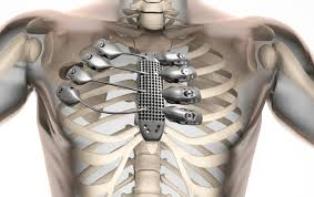
MELBOURNE: In a world-first surgery of its kind, a Spanish cancer patient has successfully received a 3D printed titanium sternum and rib implant and has recovered well.
Suffering from a chest wall sarcoma (a type of tumour that grows in and around the rib cage), the 54-year-old man needed his sternum and a portion of his rib cage replaced.

This part of the chest is notoriously tricky to recreate with prosthetics, due to the complex geometry and intricate structures involved, researchers said.
So the patient’s surgical team from Salamanca University Hospital in Spain determined that a fully customisable 3D printed sternum and rib cage was the best option.
“We thought, maybe we could create a new type of implant that we could fully customise to replicate the intricate structures of the sternum and ribs,” said Dr Jose Aranda, who was a part of the surgical team.
“We wanted to provide a safer option for our patient, and improve their recovery post-surgery,” said Aranda.
That’s when they turned to Melbourne-based medical device company Anatomics, who designed and manufactured the implant utilising Commonwealth Scientific and Industrial Research Organisation (CSIRO)’s 3D printing facility, Lab 22.
Through high resolution CT data, the Anatomics team was able to create a 3D reconstruction of the chest wall and tumour, allowing the surgeons to plan and accurately define resection margins.
The team then manufactured the implant out of surgical grade titanium alloy.
“We built the implant using our USD 1.3 million Arcam printer,” Alex Kingsbury from CSIRO’s manufacturing team said.
“The printer works by directing an electron beam at a bed of titanium powder in order to melt it. This process is then repeated, building the product up layer-by-layer until you have a complete implant,” said Kingsbury.
Once the prosthesis was complete it was couriered to Spain and implanted into the patient.


You might also like

Tesla driverless system to use updated radar technology

12/09/2016

Apple to develop its own self-driving technology

10/09/2016

Related Stories

Tesla driverless system to use updated radar technology

byCT Report
12/09/2016

WASHINGTON: Electric carmaker Tesla announced Sunday it was upgrading its Autopilot software to use more advanced radar technology. In a...

Apple to develop its own self-driving technology

byCT Report
10/09/2016

SAN FRANCISCO: Apple may not become an automaker, but it still wants to develop its own self-driving technology. The iPhone-maker's...

NASA spots slowest known magnetar

byCT Report
10/09/2016

WASHINGTON: Astronomers have found evidence of a magnetar - magnetised neutron star - that spins much slower than the slowest...

‘YouTubers’ outshining old-school television

byCT Report
09/08/2016

SAN FRANCISCO: A media revolution is taking place, and most people over 35 years of age aren’t tuned in. Millennial...

Next Post

Whisky that returned from space has different taste, scientists

  • Terms and Conditions
  • Disclaimer

© 2011 Customs Today -World's first newspaper on customs. Customs Today.

No Result
View All Result
  • Transfers and Postings
  • Latest News
  • Karachi
  • Islamabad
  • Lahore
  • National
  • Chambers & Associations
  • Business
  • About Us

© 2011 Customs Today -World's first newspaper on customs. Customs Today.

