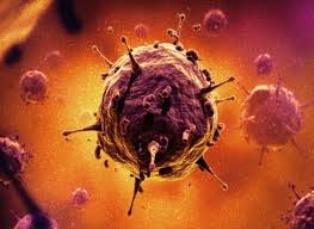


BAMAKO: It might have happened anyway. After all, global warming is melting Arctic permafrost just fine without help from microbiologists, and within that permafrost are potentially all sorts of bad and very strange things waiting to be revived—like giant viruses.
For their part, scientists haven’t had a very hard time finding those giant viruses. From a single sample of Siberian permafrost, they’ve managed to come up with two so far. The first of those, Pithovirus sibericum, was discovered/isolated last year, while the most recent find, Mollivirus sibericum, is described in a study published this week in the Proceedings of the National Academy of Sciences. Both are examples of rare giant viruses, e.g. those easily visible using optical microscopes.
So, are these giant viruses going to wipe out human civilization? Well, the work was done in a top secret CDC lab, according to an AFP report. The microbiologists behind the find, a group drawn mostly from institutions in France and Russia, assure that before “waking” the virus up they will need to verify that it is harmless to humans. This will be accomplished by using the virus to infect single-celled amoeba, which will serve as its host.
“A few viral particles that are still infectious may be enough, in the presence of a vulnerable host, to revive potentially pathogenic viruses,” study co-author Jean-Michel Claverie told AFP. “If we are not careful, and we industrialise these areas without putting safeguards in place, we run the risk of one day waking up viruses such as small pox that we thought were eradicated.” That is sort of reassuring, I guess.
Mollivirus sibericum is only the fourth known giant virus. All of them date from pre-historic times. The first find came in 2003 with the identification of the Mimivirus family, enormous viruses that were first isolated in 1992 in water taken from a cooling tower during a pneumonia outbreak (caused by bacteria, not the virus). The Mimiviruses come equipped with a startling 979 protein-encoding genes, (at the time of discovery) vastly more than any other known virus. Influenza A, for example, comes with a mere eight genes, while the minimum to be considered a virus is four. By an almost incomprehensible degree, these are the most complex viruses known.

Karachi Port sets 138-year cargo handling record
KARACHI: Pakistan's maritime sector has achieved a major milestone as Karachi Port set a new record in its 138-year history...