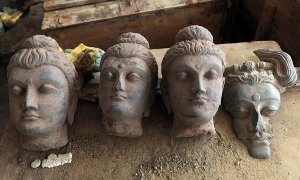
NEW DELHI: Existing measures to protect India’s rich heritage have proven to be woefully inadequate.
Indian Tourism and Culture Minister Mahesh Sharma’s recent admission in parliament that eight cases of antiquities theft were reported from State-protected monuments and museums across three states over the last year, has yet again brought to the fore the fraught issue of pilferage and smuggling of art treasures from Indian shores.
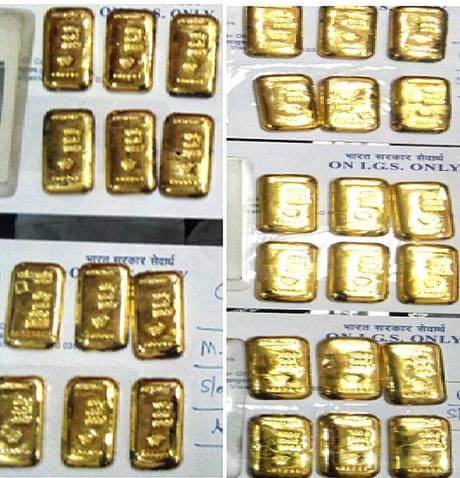
According to Global Financial Integrity, a Washington-based advocacy group, illegal trade in paintings, sculptures, and other artifacts is one of the world’s most lucrative criminal enterprises, estimated at $6 billion a year. And India, with its redoubtable cultural heritage, bureaucratic apathy, and tardy implementation of antiquities protection laws, offers pilferers fertile ground to plunder the past and spirit away booty worth billions for sale in the international bazaar.
This exploitation continues unabated despite the existence of The Antiquities and Art Treasures Act, 1972 whose aim is to protect “antiquities,” an omnibus term that includes, among other items, sculptures in stone, shrines, terracotta, metals, jewelry, ivory, paintings in paper, wood, cloth, skin, and manuscripts over a hundred years old.
The Antiquities Act also mandates that owners of such art pieces register them with the Archaeological Survey of India (ASI), the nodal agency responsible for archaeological excavations, conservation of monuments, and protection of heritage sites. The law also prohibits export of antiquities while permitting their sale within the country only under a license. Failure to comply with these rules can result in jail sentences of up to three years, a fine, or both. In what is seen as a blatantly unfair clause, the Act also empowers the State to compulsorily acquire an art object from its owner without any reliable assessment of a fair price.
Yet despite the punitive nature of law, Indian antiquities worth billions continue to be smuggled out of the country or hoarded in private collections sans documentation. Among the most audacious of Indian smugglers has been Subhash Kapoor, currently on trial in the southern state of Tamil Nadu. In 2011, Kapoor, owner of the “Art of the Past” gallery in Manhattan, was nabbed in Germany and subsequently extradited to India. Among other activities, he is alleged to have sold the 900-year-old bronze Nataraja for $5 million to the National Gallery of Australia in 2008 and a 1,100 year-old stone sculpture of Shiva to the Art Gallery of New South Wales in 2004.