

Customs Today
  • Home
  • Islamabad
  • Karachi
  • Lahore
  • National
  • Transfers and Postings
  • Chambers & Associations
  • Business
No Result
View All Result
Customs Today
  • Home
  • Islamabad
  • Karachi
  • Lahore
  • National
  • Transfers and Postings
  • Chambers & Associations
  • Business
No Result
View All Result
Customs Today
No Result
View All Result
Home Science & Technology Science

Researchers found hot Jupiter orbiting 20 times closer to host star than Earth

byCustoms Today Report
18/09/2015
in Science, Science & Technology
Share on FacebookShare on Twitter

You might also like

Tesla driverless system to use updated radar technology

12/09/2016

Apple to develop its own self-driving technology

10/09/2016

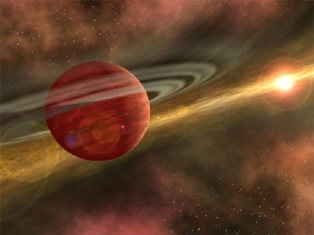
HARROW: Hot Jupiters, which are gas giants that orbit close to their star, largely remain mysterious. Now, though, researchers have aimed at solving this mystery by looking at them at bit more closely. They’ve found that these planets may only take a few million years to migrate close to their newly formed star.
In our solar system, rocky planets like Earth and Mars can be found near the sun. Gas giants, though, are found further away. That’s why researchers were surprised when they found a hot Jupiter orbiting twenty times closer to its host star than the Earth does to the sun.
Since then, astronomers have shown that these future “hot Jupiters” form in the outer regions of the protoplanetary disc, which is the cloud of dust and gas from which the central star and its surrounding planets are born. Then, the hot Jupiters migrate inwards, getting close to their host star and heating up.
But what causes these hot Jupiters to migrate? In order to find out, the researchers observed stars in formation in a stellar nursery in the constellation Taurus, located 450 light-years from Earth. One of these stars, named V830 Tau, exhibited signatures similar to those caused by a planet 1.4 times more massive than Jupiter, but orbiting 15 times closer to its star. This suggests that hot Jupiters may be extremely young and far more frequently found around stars in formation than around mature stars.
The findings reveal a bit more about how hot Jupiters form. With that said, the researchers hope to gather more data to validate the signal of the hot Jupiter and possibly look for other examples in the future.

Related Stories

Tesla driverless system to use updated radar technology

byCT Report
12/09/2016

WASHINGTON: Electric carmaker Tesla announced Sunday it was upgrading its Autopilot software to use more advanced radar technology. In a...

Apple to develop its own self-driving technology

byCT Report
10/09/2016

SAN FRANCISCO: Apple may not become an automaker, but it still wants to develop its own self-driving technology. The iPhone-maker's...

NASA spots slowest known magnetar

byCT Report
10/09/2016

WASHINGTON: Astronomers have found evidence of a magnetar - magnetised neutron star - that spins much slower than the slowest...

‘YouTubers’ outshining old-school television

byCT Report
09/08/2016

SAN FRANCISCO: A media revolution is taking place, and most people over 35 years of age aren’t tuned in. Millennial...

Next Post

Two supermassive black holes about to smash together in constellation Virgo

  • Terms and Conditions
  • Disclaimer

© 2011 Customs Today -World's first newspaper on customs. Customs Today.

No Result
View All Result
  • Transfers and Postings
  • Latest News
  • Karachi
  • Islamabad
  • Lahore
  • National
  • Chambers & Associations
  • Business
  • About Us

© 2011 Customs Today -World's first newspaper on customs. Customs Today.