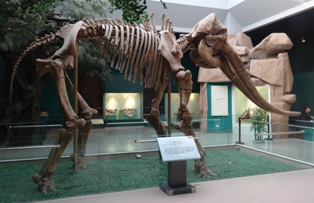
LONDON: Other animals alive at the time, during the Permian era, are thought to have “sprawled”, like modern lizards.Analysis of fossil bones belonging to Bunostegos akokanensis showed that it was different from any of its relatives.
Dr Linda Tsuji, from the Royal Ontario Museum in Canada, who helped uncover the African fossils, said: “Imagine a cow-sized, plant-eating reptile with a knobby skull and bony armour down its back.”
The study showed that the creature’s forelimb shoulder joint was facing down, so that its humerus – the bone running to the elbow – would have been positioned vertically beneath.
Unlike that of sprawlers, the humerus was not twisted. In a lizard-like sprawler, the twist allows the humerus to jut out sideways at the shoulder and then bend down from the elbow.
In addition, movement of the elbow joint was limited, only allowing the forearm to swing backwards and forwards like a human knee.
Co-author Morgan Turner, from Brown University in the US, said: “The elements and features within the forelimb bones won’t allow a sprawling posture. That’s unique.”
Learning how to stand on all fours may have been linked to the creature’s habitat, say the scientists who report their findings in the Journal of Vertebrate Paleontology.
Bones of several of the animals were found in Niger, which was an arid region 260 million years ago. Walking upright on all fours is more energy efficient than sprawling and would have made longer journeys between meals possible.
Standing on all fours evolved independently in reptiles and mammals several times.
Ms Turner said: “There are many complexities about the evolution of posture and locomotion we are working to better understand every day. The anatomy of Bunostegos is unexpected, illuminating and tells us we still have much to learn.

Karachi Port sets 138-year cargo handling record
KARACHI: Pakistan's maritime sector has achieved a major milestone as Karachi Port set a new record in its 138-year history...