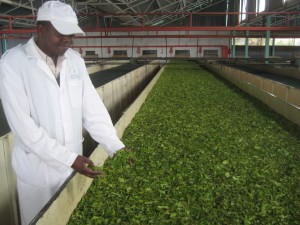
NAIROBI: The Kenya Tea Development Agency (KTDA) has got a major boost in bid to lower production cost in its factories after two multilateral organisations agreed to foot part of the Sh8.9 billion budget it requires to set up seven hydro-power plants.
The International Finance Corporation (IFC) and the Global Agriculture Food Security Programme (GAFSP) will extend a Sh2.6 billion loan to finance the authority’s internal energy plan which seeks to generate 16 megawatts.


The IFC and GAFSP have each committed to invest Sh1.3 billion into the renewable power project that will comprise seven run-of-the-river small hydropower plants (SHPs) and construction of transmission lines in various parts of the country.
“This project when completed will result in a significant energy cost saving for tea factories thus increasing financial benefits to farmers,” IFC said in a disclosure note dated September 16 .
The KTDA management has frequently cited high cost of production as part of the reasons the bonus paid to small scale farmers has reduced over the years. Official data indicates that energy costs account for about 30 per cent of the operation costs in tea factories with electricity alone accounting for 17 per cent.
On average, individual KTDA tea factories spend between Sh30 million to Sh65 million annually on electricity, depending on size, crop level and variable costs such as fuel cost adjustment and forex that the Kenya Power use to calculate electricity bills.
The KTDA – with a membership of about 562,000 small scale tea farmers and 54 tea companies – forecasts to cut its power bill by half by turning to its own power sources. This would translate to potential savings of Sh1 to Sh2 per kilogramme of green leaf delivered by farmers, KTDA said.
Each of the seven small hydropower plants will have an installed capacity ranging from 1.1MW to 6.5MW. They are to be located in Kirinyaga, Meru, Kericho and Kisii. According to the IFC disclosure, the SHPs will generate power for KTDA’s tea factories and sell any excess to Kenya Power .
“We want to have a sustainable energy mix that will ensure our factories operate at the lowest possible energy cost while retaining the tea quality KTDA is renowned for,” said KTDA Power general manager Lucas Gakori Maina.
The projects will be managed by KTDA Power , a subsidiary established by KTDA in 2010 as part of a strategy to reduce energy costs. KTDA Power is presently developing a portfolio of small, run-of-the-river SHPs with an aggregate generation capacity of up to 29MW across 10 sites in various locations in Kenya .
Three out of these 10 sites are fully funded while the remaining seven sites will be covered by IFC’s financing. Each SHP will be owned by newly created asset holding companies, Regional Power Companies (RPCs). In turn, each RPC is jointly owned by several KTDA Tea Factories located in the region where the relevant SHP is constructed.
KTDA is Kenya’s pioneer independent power producer (IPP) player in hydro and owns a 1MW plant located in Imenti. The power is used at Imenti Tea Factory with the balance of 0.3MW being sold to the grid. The small-scale tea farmers earned Sh803,000 from selling electricity to Kenya Power in the year to June 2014 .