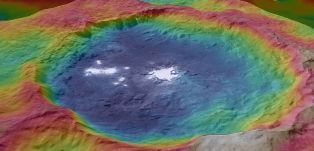


HARROW: NASA has spent months probing ever-sharper images of dwarf planet Ceres sent back from the Dawn spacecraft. Now, the space agency thinks it has a pretty good guess about the source of a series of mysterious bright spots reflecting back from the surface of the largest object in the asteroid belt.
“We believe this is a huge salt deposit,” Dawn’s principal investigator Chris Russell told a crowd of scientists Monday at the European Planetary Science Congress in Nantes, France, in a talk that was posted online Thursday. “We know it’s not ice and we’re pretty sure it’s salt, but we don’t know exactly what salt at the present time. ”
This may come as something of a surprise to many watching the drama on Ceres unfold who guessed that the spots were reflective ice. That’s because the dwarf planet is believed to harbor a subsurface ocean that could have been exposed and then frozen by asteroid impacts.
Russell also explained that the presence of salt in those bright spots would indicate that the surface of Ceres is active and that the salts are “derived from the interior somehow” rather than being carried by an asteroid that impacted Ceres in the past. He cautioned that NASA does not yet have a good understanding of how the salt gets out onto the surface, which seems to be entirely dry.

Karachi Port sets 138-year cargo handling record
KARACHI: Pakistan's maritime sector has achieved a major milestone as Karachi Port set a new record in its 138-year history...