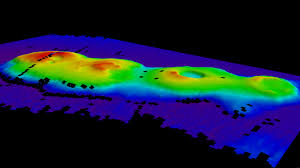


SYDNEY: A wall of fire has just been discovered on the eastern side of Australia, making this fiery and blazing land one of the world’s longest chain of volcanoes. Approximately 1,243 miles long, this chain spans from northern Hillsborough all the way to the southern island of Tasmania. With such a large discovery of volcanic activity, it is safe to say there will be a possibility of more super volcanoes in the making. With this new discovery, Australia has gotten a little deadlier; its animals are no longer the only things to be worrying about.
Before this discovery, scientists had an understanding that there were four separate volcanic structures across eastern Australia. There were some speculations on where they were located but with lava fields and leucitite (a dark grayish black igneous rock specific to being associated with volcanic minerals), a good portion of the locations were already previously discovered. Through looking at old and new data collected, scientists researching the Australian volcanoes have finally found that these seemingly separate volcanic sites have actually been a place in which the sites are inter-connected.
As of now, the region is classified as a super-chain of volcanoes since the structure of the volcanic activity are from the same vein of the mantle plum. The mantle plum is a source of magma on the boundaries of tectonic plates, seeping through the cracks of the Earth. It has been donned the name of the Cosgrove, supposedly formed between 9 million and 33 million years ago.
While the formation is considered active, the largeness of it does give a varying degree of activity, with some sections extremely susceptible to volcanic eruptions while others are barely even a threat. The multitude of spots on the super-chain are measured by the lithosphere (the outermost shell of the Earth) on the Australian tectonic plate. The parts that are extremely susceptible to actually erupt or produce magma at the surface are the thin sections of the lithosphere. In contrast, the safest parts of the lithosphere would be the thickest parts, where the mantle plume would be too deep to penetrate through the crust.

Karachi Port sets 138-year cargo handling record
KARACHI: Pakistan's maritime sector has achieved a major milestone as Karachi Port set a new record in its 138-year history...