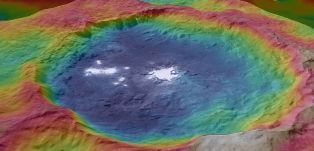


HONG KONG: As NASA’s Dawn spacecraft zeros in on the dwarf planet Ceres, it captured images that reveals intriguing details about the tiny world.
So of the names include Jaja, after the Abkhazian harvest goddess, and Ernutet, after the cobra-headed Egyptian harvest goddess. Special filters were used to create the false-color view.
“We’re having challenges becoming familiar with what actually made that often hill”, said Chris Russell beginning with the University of California Los Angeles, Dawn’s quintessential eye. NASA says that these variations are more subtle than on Vesta.
NASA’s Dawn spacecraft team released a new color-coded map that could provide a piece of the puzzle to Ceres’ mysterious bright spots located in the Occator crater and on its mountain Ysolo Mons. Included in the latest set of imagery is one of the puzzling cone-shaped 4-mile-high (6-kilometer-high) mountain. The fresh information from these maps will help scientists to understand different geological formations in the dwarf planet.
Carol Raymond, Dawn’s deputy leading investigator at JPL, tried to explain what the mystery is; it turns out that Ceres’ irregular shapes of craters are more like the craters found on Saturn’s moon, the icy Rhea. These bursts may result from the interaction between Ceres and radiation from the sun, according to NASA. “We are poking at this, and we’re looking for ideas, but we haven’t solved the problem yet”, Russell said, referring to the crater’s map. That’s because the dwarf planet is believed to harbor a subsurface ocean that could have been exposed and then frozen by asteroid impacts.
Dawn’s mission will cover the entire surface of the dwarf planet six times and send back images from an altitude of 915 miles (1,470 kilometers) on the orbit of Ceres. The spacecraft will continue imaging Ceres and taking other data at higher resolutions than ever before at this last orbit.

Karachi Port sets 138-year cargo handling record
KARACHI: Pakistan's maritime sector has achieved a major milestone as Karachi Port set a new record in its 138-year history...