

Customs Today
  • Home
  • Islamabad
  • Karachi
  • Lahore
  • National
  • Transfers and Postings
  • Chambers & Associations
  • Business
No Result
View All Result
Customs Today
  • Home
  • Islamabad
  • Karachi
  • Lahore
  • National
  • Transfers and Postings
  • Chambers & Associations
  • Business
No Result
View All Result
Customs Today
No Result
View All Result
Home Science & Technology Science

Corals worldwide at risk from bleaching, scientists

byCustoms Today Report
09/10/2015
in Science, Science & Technology
Share on FacebookShare on Twitter

You might also like

Tesla driverless system to use updated radar technology

12/09/2016

Apple to develop its own self-driving technology

10/09/2016

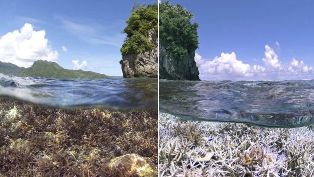
HARROW: Corals worldwide are at risk from a major episode of bleaching which turns reefs white, scientists have confirmed.
The bleaching has hit reefs in the Pacific, Atlantic and Caribbean.
The US National Oceanic and Atmospheric Administration (NOAA) warned it may affect over 38% of the world’s reefs, and kill over 12,000 sq km of reefs.
The mass bleaching is caused by rising water temperatures resulting from two natural warm currents and exacerbated by man-made climate change.
Bleaching happens when corals under stress drive out the algae known as zooxanthellae that give them colour.
If normal conditions return, the corals can recover. But the process can take decades, and if the stress continues, the corals can die.
Reefs are under multiple threats including pollution, over-fishing, sedimentation and damage from boats and tourism.
The current worldwide bleaching episode is predicted to be the worst on record as the warming Pacific current, El Nino, increases in strength. Water temperatures are being driven further by a separate natural warm-water mass dubbed the Pacific Blob.
Man-made climate change also contributes, as the oceans are absorbing about 93% of the increase in the earth’s heat.
Additionally, corals face ocean acidification as CO2 emissions are absorbed into the oceans, changing the pH of seawater.
Some scientists are warning that spectacular reefs as we know them – with branching corals and fan corals – are unlikely to survive changes in temperature and pH by the end of this century. That’s if they are not killed first by other damaging local activities.

Related Stories

Tesla driverless system to use updated radar technology

byCT Report
12/09/2016

WASHINGTON: Electric carmaker Tesla announced Sunday it was upgrading its Autopilot software to use more advanced radar technology. In a...

Apple to develop its own self-driving technology

byCT Report
10/09/2016

SAN FRANCISCO: Apple may not become an automaker, but it still wants to develop its own self-driving technology. The iPhone-maker's...

NASA spots slowest known magnetar

byCT Report
10/09/2016

WASHINGTON: Astronomers have found evidence of a magnetar - magnetised neutron star - that spins much slower than the slowest...

‘YouTubers’ outshining old-school television

byCT Report
09/08/2016

SAN FRANCISCO: A media revolution is taking place, and most people over 35 years of age aren’t tuned in. Millennial...

Next Post

Pancontinental posts Sh43b net loss after exiting Kenya

  • Terms and Conditions
  • Disclaimer

© 2011 Customs Today -World's first newspaper on customs. Customs Today.

No Result
View All Result
  • Transfers and Postings
  • Latest News
  • Karachi
  • Islamabad
  • Lahore
  • National
  • Chambers & Associations
  • Business
  • About Us

© 2011 Customs Today -World's first newspaper on customs. Customs Today.