

Customs Today
  • Home
  • Islamabad
  • Karachi
  • Lahore
  • National
  • Transfers and Postings
  • Chambers & Associations
  • Business
No Result
View All Result
Customs Today
  • Home
  • Islamabad
  • Karachi
  • Lahore
  • National
  • Transfers and Postings
  • Chambers & Associations
  • Business
No Result
View All Result
Customs Today
No Result
View All Result
Home Science & Technology Science

Saturn’s moon Enceladus reveals craters across across its snowy-white surface

byCustoms Today Report
16/10/2015
in Science, Science & Technology
Share on FacebookShare on Twitter

You might also like

Tesla driverless system to use updated radar technology

12/09/2016

Apple to develop its own self-driving technology

10/09/2016

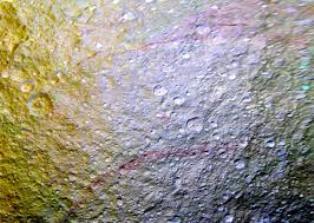
LONDON: The closest views yet of Saturn’s moon Enceladus reveal craters and fractures across its snowy-white surface.
NASA’s Cassini spacecraft sent back the first images from its October 14 flyby ranging from 1,140 to 6,000 feet above its surface, according to a release from NASA’s Jet Propulsion Laboratory (JPL). NASA released three processed images and more raw images on Thursday.
Cassini captured Enceladus’ fractured and heavily cratered north pole. So many craters cover the moon they overlap each other and wrap its icy surface. Long thin networks of cracks run through craters. The cracks on the north pole were a surprise to scientists because they were not sure the fractures went so far north, according to the imaging team.
“The northern regions are crisscrossed by a spidery network of gossamer-thin cracks that slice through the craters,” said Paul Helfenstein of Cassini’s imaging team. “These thin cracks are ubiquitous on Enceladus, and now we see that they extend across the northern terrains as well.”
In September Cassini’s imaging team confirmed a global ocean deep beneath Enceladus’ ice crust. Scientists hope later flyby images from Cassini will provide more information about the ocean’s activity.
These pictures are the closest yet of Enceladus, but the best are still to come. Cassini will zoom through the moon’s southern pole — where misting fissures have been spotted—on October 28 at an altitude of 30 miles sampling the moon’s ice geysers.
Cassini’s final encounter with Enceladus will happen in December, before it takes off to image more of Saturn’s moons.

Related Stories

Tesla driverless system to use updated radar technology

byCT Report
12/09/2016

WASHINGTON: Electric carmaker Tesla announced Sunday it was upgrading its Autopilot software to use more advanced radar technology. In a...

Apple to develop its own self-driving technology

byCT Report
10/09/2016

SAN FRANCISCO: Apple may not become an automaker, but it still wants to develop its own self-driving technology. The iPhone-maker's...

NASA spots slowest known magnetar

byCT Report
10/09/2016

WASHINGTON: Astronomers have found evidence of a magnetar - magnetised neutron star - that spins much slower than the slowest...

‘YouTubers’ outshining old-school television

byCT Report
09/08/2016

SAN FRANCISCO: A media revolution is taking place, and most people over 35 years of age aren’t tuned in. Millennial...

Next Post

NASA astronaut takes amazing images of Australia from space

  • Terms and Conditions
  • Disclaimer

© 2011 Customs Today -World's first newspaper on customs. Customs Today.

No Result
View All Result
  • Transfers and Postings
  • Latest News
  • Karachi
  • Islamabad
  • Lahore
  • National
  • Chambers & Associations
  • Business
  • About Us

© 2011 Customs Today -World's first newspaper on customs. Customs Today.