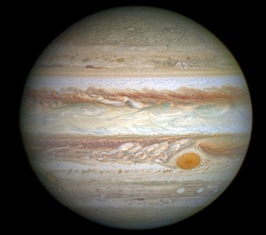


CANADA: A new video featuring Jupiter’s famous Great Red Spot has been created by scientists based on different images captured by NASA’s Hubble Space Telescope. The video is a stunning 4K rendering of these Hubble images, and is the first of a series of portraits under NASA’s Outer Planet Atmospheres Legacy (OPAL) Program.
To see the video in high-quality 4K, YouTube settings must be set to 4K viewing or 2160p, and it is best seen on an ultra HD monitor. The video also shows off various discoveries taken by Hubble’s Wide Field Camera 3 which is now celebrating more than 25 years in space.
“Every time we look at Jupiter, we get tantalizing hints that something really exciting is going on,” said planetary scientist Amy Simon from NASA’s Goddard Space Flight Center in Greenbelt, Maryland. “This time is no exception.”
Through NASA’s OPAL, scientists plan to annually capture a broad range of planetary features such as clouds, winds, storms and atmospheric chemistry of Jupiter, Saturn, Uranus and Neptune. Scientists hope to see how these giant planets change overtime.
In a study published in the Astrophysical Journal, planetary researchers discovered that the Great Red Spot is beginning to shrink and change in color, and that its long axis is now 150 miles smaller than its size in 2014. The Great Red Spot might be slowly fading because its core is becoming lighter, now turning orange from its former intense red.
The Hubble has captured a rare wave structure in the northern region of Jupiter’s equator which is dotted with anticyclones and cyclones. These waves also sometimes form in the Earth’s atmosphere.
The study featured two global maps of Jupiter created from Hubble images as well. These two maps are representations of the planet’s back-to-back rotations.
Michael H. Wong, co-author of the study, said that he finds the long-term value of the OPAL program to be really exciting.
He explained that the future collection of maps will help scientists understand giant planets’ atmospheres and quite possibly the atmospheres of other planets being discovered in the different parts of the galaxy, as well as Earth’s atmospheres and oceans.

Karachi Port sets 138-year cargo handling record
KARACHI: Pakistan's maritime sector has achieved a major milestone as Karachi Port set a new record in its 138-year history...