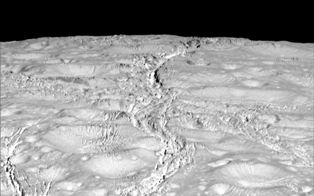


HARROW: Recently, Cassini has performed its scheduled E-20 close pass of small moon of Saturn, Enceladus. The moon has become quite famous for the organics-laden geysers firing from long fissures along its southern pole. Cassini has recently captured detailed images of Enceladus’s cratered and fractured surface from distance of 1,142 miles.
According to sources, E-20 was the first of a series of three flybys Cassini will execute before the end of 2015. The aim of three flybys is to obtain best views of North Pole of Encleadus. The views of North Pole will be best seen these days as the Saturn moves toward its summer season. Paul Helfenstein, a member of the Cassini imaging team at Cornell University, described the Northern regions of Enceladus that they are crisscrossed by a spidery network of gossamer-thin cracks that slice through the craters.
Cassini will fly by Enceladus again on Dec. 19, approaching within 3,106 miles (4,999 km) of the satellite and gathering data that should help scientists gauge how much heat is coming from the satellite’s interior.
Cassini spotted powerful water-ice geysers near Enceladus’ south pole in 2005. These jets are blasting into space material from the ocean of liquid water that sloshes beneath Enceladus’ ice shell, scientists say.
Mission scientists will scan the new flyby images for signs of activity coming from the north polar region as well, NASA officials said.
The data Cassini returns next could help scientists decide whether this moon really is a good candidate for habitability. If so, that knowledge would go a long way toward motivating a future life-finder mission.
Enceladus may be tiny —from end to end it could fit between San Francisco and LA —but this little moon’s got a larger-than-life personality. Its surface is covered entirely in ice, giving it the dazzling appearance of a perfectly packed snowball. But it’s beneath that shiny surface that things get really interesting.

Karachi Port sets 138-year cargo handling record
KARACHI: Pakistan's maritime sector has achieved a major milestone as Karachi Port set a new record in its 138-year history...