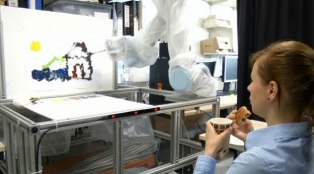
CANADA: Scientists from Imperial College London have developed computer software that enables a person to control a robotic arm to paint a picture using just the movement of their eyes.
The researchers say the technology demonstrates a potential use for robots to help people extend their range of abilities and do more than one task at a time.


At the college’s Brain and Behavior Lab, engineers have taken a robotic arm and devised a system for it to be used as an extension of the human body. Instead of following a set of computer commands, the robot arm is guided by a tracker that follows the direction of the eyes, with an algorithm translating the path of the user’s gaze into commands that control the robotic arm.
On Wednesday (October 14), in what the team says was quite possibly a world first, a researcher used the technology to paint a picture while simultaneously eating a croissant and drinking coffee. Post graduate student Sabine Dziemian said the intuitive computer program meant that even when her hands were otherwise occupied she could still accurately control the robotic arm.
“In general it’s very intuitive because I don’t have to think about commands or something like this. I simply think about where I want to draw or which color I want to take. And by thinking, a person usually looks at that color. So I also then look at that color and the robot goes there because it detects my eye movements and where I’m looking, and it has the co-ordinates exactly so it goes there directly. So I don’t have to think a lot about this when I’m controlling it,” said Dziemian.
The resulting painting is, admittedly, rudimentary. But the exercise demonstrates how the technology could be implemented into everyday life to literally give users an extra pair of hands.
Led by Dr. Aldo Faisal from the Departments of Computing and Bioengineering, the researchers developed sophisticated computer software to decode the eye movements of the user into actions.
“Six years ago we started to look at eye movements. It’s a very natural, intuitive means by which we can operate devices. And so over the course of the years we developed systems that decode our intention of action from our eye movements. So you can imagine, for example, when you want to grab a cup; you will look at that cup before you grab it. And you will look in a specific way so you can judge where it is and how wide you have to shape your grip. And so we’re developing algorithms that decode this intention from eye movement and we’re then translating them into action,” Faisal told Reuters.