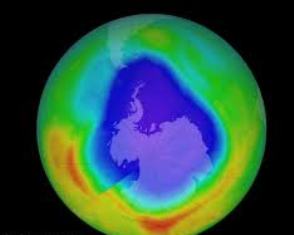


GENEVA: The UN’s weather and climate agency said on Thursday there was no cause for alarm about a record-size hole this month in the ozone layer, that shields life on earth from the sun, as it should shrink again.
The ozone hole that appears over Antarctica fluctuates in size, normally reaching its widest in the polar spring as extreme cold temperatures in the stratosphere and the return of sunlight unleash chlorine radicals that destroy ozone.
Last year, the World Meteorological Organization (WMO) said it detected the first sign of ozone recovery, largely thanks to a 1987 ban on gases that cause ozone depletion, but said it could be a decade before the hole begins shrinking. This year, a colder than usual stratosphere widened the hole to a peak of 28.2 million square km (10.9 million square miles) on Oct. 2, bigger than Canada and Russia put together. It was a record for a hole recorded on Oct. 2 of any year, and the hole has remained at daily record levels on every day since then, the WMO said, citing data from NASA. Over the 30 days around the peak, the hole averaged 26.9 million square km, making it the third largest, after 2000 and 2006.
“This shows us that the ozone hole problem is still with us and we need to remain vigilant. But there is no reason for undue alarm,” WMO Atmospheric and Environment Research Division senior scientist Geir Braathen said in a statement. “Overall, however, this does not reverse the projected long-term recovery in the coming decades,” the statement said. Ozone depleting chemicals, including the chlorofluorocarbons (CFCs) once widely used in refrigerators and spray cans, were banned under the 1987 Montreal Protocol. The UN Environment Programme has said the treaty will prevent 2 million cases of skin cancer annually by 2030. “The Montreal Protocol is in place and is working well,” Braathen said. “But we may continue to see large Antarctic ozone holes until about 2025 because of weather conditions in the stratosphere and because ozone depleting chemicals linger in the atmosphere for several decades after they have been phased out.”

Karachi Port sets 138-year cargo handling record
KARACHI: Pakistan's maritime sector has achieved a major milestone as Karachi Port set a new record in its 138-year history...