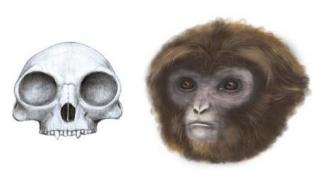
HONG KONG: The well-preserved partial skull and skeleton of a gibbon-like creature that lived 11.6 million years ago in Spain is shedding new light on the evolutionary history of modern apes.
Scientists have announced the discovery of fossil remains in Catalonia of a small, fruit-eating female ape that lived in a warm, wet forested region teeming with animals including elephant relatives, rhinos and saber-toothed predators.


They gave the ape, weighing between four and five kilograms, the scientific name Pliobates cataloniae and the nickname “Laia”.
“There is no living primate like Pliobates, which exhibits a unique combination of modern ape-like features with other, more primitive ones,” said palaeobiologist Dr David Alba of the Catalan Institute of Paleontology near Barcelona.
“We can imagine a small ape, like the smallest living gibbons, with a gibbon-like appearance regarding the cranium, but with different body proportions: less elongated arms and hands.”
Dr Alba said Pliobates, which lived during the Miocene epoch, moved through the forest canopy differently than today’s gibbons, using slow and cautious climbing, like a loris, a more primitive primate, while sometimes hanging below branches.
The remains included 70 bones or bone fragments, including a skull exceptionally complete for a primate from that time.