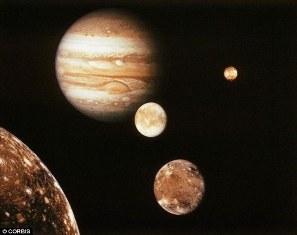
CANADA: It is well-known that the solar system currently includes four gas giants in its family of eight planets (excluding Pluto), but a group of scientists revealed that during the early formation of the solar system, there may have been five gas giants and Jupiter or Saturn may have kicked one out of orbit. However, scientific evidence mostly points to Jupiter as the culprit, scientists say.
Researchers from the University of Toronto said that planet ejections were the result of a close encounter in which a planet was accelerating too fast that it might have had to slingshot itself out of the solar system.


“Our evidence points to Jupiter,” said Ryan Cloutier, lead researcher from the university’s Astronomy and Astrophysics Department.
Scientists said that Jupiter was more capable of ousting the unknown planet with a likelihood of 42 percent ice giant ejection (IGE), while Saturn could have found it difficult to do so.
To find out how Jupiter managed to eject the hypothetical planet, Cloutier and his colleagues developed simulations based on the current trajectories of Iapetus and Callisto, respective moons of Saturn and Jupiter.
The team calculated the probability of each moon creating its current orbit if its host planet was responsible for ejecting the unknown planet. The occurrence would have caused significant disturbance to each moon’s original orbit, scientists explained in the study published in The Astrophysical Journal.
Previous studies which also looked into the possibility of planet ejections did not take into account how violent encounters such as the one between Jupiter and the unknown planet affected the gas giants’ satellites. The study said that Jupiter may have ejected the hypothetical planet while still retaining Callisto in its orbit.