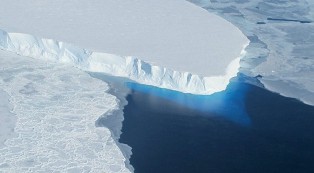
HARROW: An increase in Antarctic snow accumulation that began 10,000 years ago is currently adding enough ice to the continent to outweigh the increased losses from its thinning glaciers.
Areas of the continent like the Antarctic Peninsula have increased their mass loss in the last decades, says a new NASA study.


The research challenges the conclusion of other studies, including Intergovernmental Panel on Climate Change’s 2013 report which says that Antarctica is overall losing land ice.
According to the analysis of satellite data, the Antarctic ice sheet showed a net gain of 112 billion tonnes of ice a year from 1992 to 2001. The net gain slowed to 82 billion tonnes of ice per year between 2003 and 2008.
“We are essentially in agreement with other studies that show an increase in ice discharge in the Antarctic Peninsula and the Thwaites and Pine Island region of West Antarctica,” explained Jay Zwally, glaciologist with NASA Goddard Space Flight Centre in Greenbelt, Maryland.
Our main disagreement is for East Antarctica and the interior of West Antarctica.
“Here, we see an ice gain that exceeds the losses in the other areas,” he added.
But it might take a few decades for Antarctica’s growth to reverse, according to Zwally.
The study analysed changes in the surface height of the Antarctic ice sheet measured by radar altimeters on two European Space Agency satellites and by the laser altimeter on NASA’s Ice, Cloud, and land Elevation Satellite (ICESat).
“At the end of the last Ice Age, the air became warmer and carried more moisture across the continent, doubling the amount of snow dropped on the ice sheet,” Zwally noted.
“The good news is that Antarctica is not currently contributing to sea level rise, but is taking 0.23 mm per year away,” Zwally said. But this is also bad news.
“If the 0.27 mm per year of sea level rise attributed to Antarctica in the IPCC report is not really coming from Antarctica, there must be some other contribution to sea level rise that is not accounted for,” he pointed out in the study appeared in the Journal of Glaciology .IANS