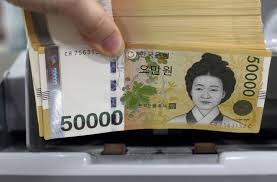
SEOUL: South Korea’s won dropped to the lowest in a month and government bonds tumbled after stronger-than-expected U.S. jobs figures boosted bets the Federal Reserve will increase interest rates in December.
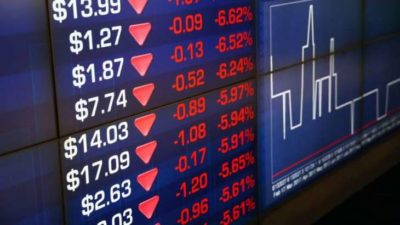
The Kospi index of shares fell for a third day as foreigners were set to sell more stocks than they will buy after data showed American employers added more jobs in October than the highest estimate of economists surveyed by Bloomberg. A gauge of the dollar against 10 major peers surged the most since March on Friday after the report. The won pared this quarter’s gains that had largely occurred due to uncertainty about whether the Fed will raise borrowing costs this year, according to Nonghyup Bank.
The won dropped 0.9 percent to 1,152.52 a dollar as of 10:32 a.m. in Seoul, data compiled by Bloomberg show. The currency earlier reached 1,155.29, the weakest since Oct. 9, and is still 2.9 percent stronger than at the end of September. The Kospi declined 0.4 percent.
“A U.S. rate increase is in sight after the jobs report, and it’s better to sell the won for now,” said Park Dae Bong, a senior currency trader at Nonghyup Bank in Seoul, predicting a decline to as low as 1,165 this week. “Korean exporters, who were waiting for the dollar to strengthen, will help support the won.”
The Bank of Korea will keep its benchmark interest rate at a record low of 1.5 percent when it reviews monetary policy on Nov. 12, according to all 17 economists surveyed by Bloomberg.
South Korea’s government bonds fell, pushing the three-year yield up six basis points to 1.79 percent, the highest since Aug. 7, Korea Exchange prices show. The 10-year yield advanced eight basis points to 2.28 percent, the highest since Sept. 17.