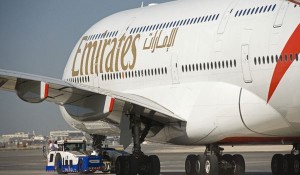
DUBAI: Dubai’s Emirates airlines yesterday said it signed a $16 billion service contract with GE’s aviation unit for engines powering the airline’s 777x fleet. The contract will include maintenance, repair and overhaul (MRO) of the GE9X engines that will power the airline’s fleet of 150 Boeing 777X aircraft over a period of 12 years, it said in a statement. Emirates last year placed a record $76 billion order for 150 Boeing 777X twin-engine aircraft, powered by GE’s new GE9X engine – the only engine available for the 777x wide-body aircraft – valued at $16 billion at list price for 300 units.
Emirates said it also signed a second services contract with GE Aviation for its existing 777 fleet for further 12 years, valued at $36 million. Emirates National Oil Co Ltd (ENOC) yesterday announced the completion of a new jet fuel pipeline from its storage terminals to Dubai International Airport (DXB) to cope with an expected increase in demand. The $250 million project will be able to pump 850 cubic metres of jet fuel per hour to the airport, which is 55 percent of its total demand, the Dubai governmentowned company said in a statement at the Dubai Airshow.

ENOC also plans to extend the pipeline to Dubai’s second hub, Al Maktoum International Airport (DWC), CEO Saif Al Falasi said. Dubai International Airport carried more than 70 million international passengers last year, more than any other airport, and has continued to grow this year. With the primary airport nearing capacity, Dubai is encouraging airlines to expand into Al Maktoum International, a sprawling facility outside the city that currently serves just five airlines, despite a projected capacity above 200 million passengers a year.
Zaid Al Qufaidi, Managing Director of ENOC Marketing, said the new pipeline project was expected to meet growing demand from both airports until the mid-2030s. “We are on the cusp of a steep growth trajectory as airlines around the world take advantage of the depressed fuel market,” he said, referring to a slump in oil prices since mid-2014. The United Arab Emirates (UAE) has bought two Bombardier Global 6000 jets with surveillance equipment from Sweden’s SAAB in a deal worth $1.27 billion, a defence ministry official said yesterday.
Major General Abdullah al-Hashimi, the ministry’s executive director of strategic analysis, said UAE was also in talks about upgrading the radar systems of two older SAAB turboprop planes and would decide whether to proceed within two years. “The two radars will be close and similar to each other,” Hashimi said at the Dubai Airshow, referring to the new system and the planned systems upgrade of its two Saab 340s, a twin-engine turboprop aircraft. Saab will deliver the new airborne surveillance system based on “Saab Erieye”, which is a high-performance, long-range airborne early warning and control radar system.
It will use Canadian planemaker Bombardier’s Global 6000, a long-range and large cabin business jet. Hakan Buskhe, president and chief executive of SAAB, said the company was “heavily invested” in the Middle East. “Surveillance overall is extremely important here, the market potential is huge,” he said at the Airshow. Buskhe declined to comment on whether SAAB had seen any impact on demand from increased conflict in the Gulf or falling oil prices. “We try to be extremely affordable, but can’t speculate on impact from oil prices,” he said. Conflicts in Iraq, Syria and Yemen have increased demand for surveillance and for border security. Weapon makers are looking for opportunities to meet that demand by equipping manned and unmanned sensors for security and surveillance.