
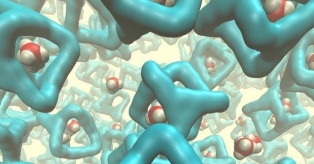
LONDON: Researchers at Queen’s University Belfast in UK, along with peers from University of Liverpool and other international partners, have created the world’s first ‘liquid with permanent porosity’ which can be used to capture harmful carbon emissions and stop them from entering Earth’s atmosphere. The liquid has ‘holes’ in it which absorb incredibly large amounts of gas. This study could pave way to a greener and more efficient chemical processes, including carbon capture – a procedure where carbon dioxide is trapped into the liquid while coming out from major sources (say a fossil-fuel power-plant) and is stored in such a way that it never enters the atmosphere.
Stuart James from Queen’s School of Chemistry and Chemical Engineering stated that such materials which contain permanent pores or holes are technologically important, as they’re employed in the manufacturing of an array of products from plastic bottles to petroleum. Until now, the porous materials have been solid. Porous solids like zeolites or metal–organic frameworks (MOFs) are extremely common in chemical processes, as they’re rigid and have permanent cavities of fixed sizes/shapes. Their solid nature may impose limitations in some cases, and here’s where fluidity paired with permanent porosity is of huge technological importance. What the researchers have done is design a special liquid from the ‘bottom up’, that is, they first designed the shape of the molecules which form the liquid so that the liquid does not fill up the space. Due to the empty holes they had created in the liquid, they observed that it was now capable of absorbing huge quantity of gas. The initial experiments are key to understand this new material, and the results as of now show room from interesting long-term applications which rely on the dissolution of gases. Some more years need to be invested in the research, but the researchers are hopeful that these porous liquids could better the existing chemical processes.





