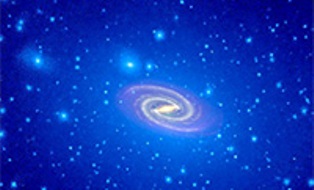
LONDON: At the edge of the Milky Way, there’s a small galaxy called Triangulum II. It has just 1,000 stars, compared to the 100 billion estimated in our own galaxy, and its days of star formation are over, leaving it “dead”. But Triangulum II may have a dark secret – one that makes it the most interesting ghost town in space.
The nearby neighborhood may have the highest concentration of dark matter ever found within a galaxy.


In a paper published Tuesday in the Astrophysical Journal Letters, researchers suggest that the mysterious, unseen matter may be responsible for Triangulum II’s abysmally low star count.
First, a refresher on dark matter from an earlier post:
“It’s a term for the as-of-yet unobserved matter that must be bulking up cosmos, giving galaxies the gravity they need to spin at the rates they do without falling to pieces. But even though we haven’t caught dark matter (so named because it doesn’t interact with light the way normal matter does – not absorbing or reflecting it – though it does bend light with a weird lensing effect) in a straightforward observation, scientists can learn about it based on the effects it has on more typical, observable forms of matter.”
Scientists are still trying to hone in on how little dark matter interacts with the rest of the Universe. For now, the answer seems to be: perplexingly little, but enough to keep things interesting.
As always, researchers in this study are detecting dark matter based on its effects – and the absence of anything more likely to cause those effects.
“The total mass I measured was much, much greater than the mass of the total number of stars-implying that there’s a ton of densely packed dark matter contributing to the total mass,” study author and Caltech Assistant Professor of Astronomy Evan Kirby said in a statement.
To measure the gravitational forces influencing the inner workings of the galaxy – in other words, tell-tale signs of dark matter – Kirby and his colleagues had to rely on just six visible stars. The rest were all too dim.
“The ratio of dark matter to luminous matter is the highest of any galaxy we know. After I had made my measurements, I was just thinking – wow,” Kirby said.