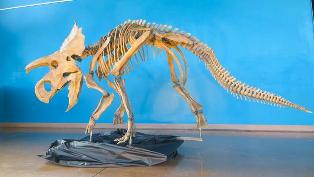
EUROPE: A new species of dinosaur was discovered at north central Montana which could be a missing link in evolution. A team from Montana State University has unearthed a dinosaur fossil nearly 79 million years old.
The fossil has been found to be that of a duck-billed dinosaur that was most probably the ancestor of the state’s dinosaur, the Maiasaura.


Elizabeth Freedman Fowler, who was also a curator of paleontology at the Great Plains Dinosaur Museum in Malta, said, “When everything was cleaned, it revealed this little crest [on its head] like nothing we’d ever seen”.
They named the fossil as Probrachylophosaurus bergei which roughly means early short-crested lizard. The characteristics of the fossil fit between the Acristavus gagslarsoni, a dinosaur that lived nearly 80 million years back with no crest on its head, and the Brachylophosaurus canadensis from around 77 million years back that used to have a huge, flat crest on its nose.
It was also called the Super Duck due to its size, being among the larger members of the duck-billed dinosaur family. Scientists said the crest on the dinosaurs could have the similar purposes as the ones of present day birds. Some birds have feathers-made crests or keratin-made crests, whose size and shape grows as they become mature. Their main purpose is to attract mates.
Fowler said that the Probrachylophosaurus’ crest is tiny and triangular, and would have just poked up slightly on the head’s top, over the eyes.
Furthermore, Fowler said because the crest’s size on the dinosaurs has apparently grown larger in different members of its family with time, evolution could have taken this trait as a valuable one, retaining it over different species.