Customs Today
  • Home
  • Islamabad
  • Karachi
  • Lahore
  • National
  • Transfers and Postings
  • Chambers & Associations
  • Business
No Result
View All Result
Customs Today
  • Home
  • Islamabad
  • Karachi
  • Lahore
  • National
  • Transfers and Postings
  • Chambers & Associations
  • Business
No Result
View All Result
Customs Today
No Result
View All Result
Home Science & Technology Science

Scientists find a technique to harness electrical energy from blue-green algae

bySana Anwar
27/11/2015
in Science, Science & Technology
Share on FacebookShare on Twitter

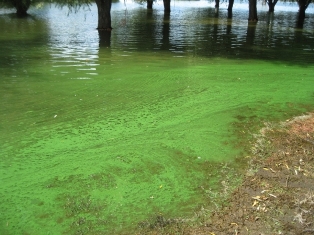
WASHINGTON: Amid the global mission to reduce fossil fuel dependence and explore new, renewable energy sources, researchers from Montreal’s Concordia University have blue-green algae as the answer.

Research published in Technology journal introduced the team’s discovery: a power cell harnessing energy from blue-green algae’s photosynthesis as well as respiration.


You might also like

Tesla driverless system to use updated radar technology

12/09/2016

Apple to develop its own self-driving technology

10/09/2016

“Both photosynthesis and respiration … involve electron transfer chains,” said study lead and engineering professor Muthukumaran Packirisamy, explaining that humans can get the energy the algae naturally produce when they trap the electrons they release.

And such algae are everywhere, making them a sound, sustainable option.

Blue-green algae, also identified as cyanobacteria, are the top microorganisms on the planet when it comes to abundance. They live in so many habitats and have been around for so long, with early biology owing their makeup to these algae that create the oxygen needed for higher life forms to thrive.

Packirisamy believed it’s high time to take advantage of this constantly occurring process. “[W]e’ve created a new and scalable technology that could lead to cheaper ways of generating carbon-free energy,” he said.

The invention is currently in early-stage development: the power cell remains on a small scale, consisting of a membrane for anode, cathode, and proton exchange, and with the anode chamber housing the algae.

As photosynthesis occurs, the blue green algae provide electrons to the electrode surface, which is then extracted by an external load connected to the unit.


Related Stories

Tesla driverless system to use updated radar technology

byCT Report
12/09/2016

WASHINGTON: Electric carmaker Tesla announced Sunday it was upgrading its Autopilot software to use more advanced radar technology. In a...

Apple to develop its own self-driving technology

byCT Report
10/09/2016

SAN FRANCISCO: Apple may not become an automaker, but it still wants to develop its own self-driving technology. The iPhone-maker's...

NASA spots slowest known magnetar

byCT Report
10/09/2016

WASHINGTON: Astronomers have found evidence of a magnetar - magnetised neutron star - that spins much slower than the slowest...

‘YouTubers’ outshining old-school television

byCT Report
09/08/2016

SAN FRANCISCO: A media revolution is taking place, and most people over 35 years of age aren’t tuned in. Millennial...

Next Post

China to imports broader range of goods from Africa

  • Terms and Conditions
  • Disclaimer

© 2011 Customs Today -World's first newspaper on customs. Customs Today.

No Result
View All Result
  • Transfers and Postings
  • Latest News
  • Karachi
  • Islamabad
  • Lahore
  • National
  • Chambers & Associations
  • Business
  • About Us

© 2011 Customs Today -World's first newspaper on customs. Customs Today.