Customs Today
  • Home
  • Islamabad
  • Karachi
  • Lahore
  • National
  • Transfers and Postings
  • Chambers & Associations
  • Business
No Result
View All Result
Customs Today
  • Home
  • Islamabad
  • Karachi
  • Lahore
  • National
  • Transfers and Postings
  • Chambers & Associations
  • Business
No Result
View All Result
Customs Today
No Result
View All Result
Home Science & Technology Science

Researchers discover dinosaur footprints in Scotland

bySana Anwar
04/12/2015
in Science, Science & Technology
Share on FacebookShare on Twitter

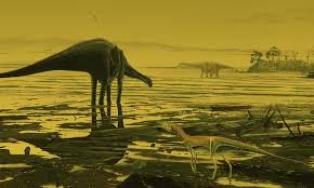
LONDON: A team of researchers were able to discover a collection of dinosaur footprints in Scotland, revealing information regarding the habitats and behaviors of the jurassic giants.

The Middle Jurassic era is filled with rich evolutionary changes, however, fossils and data from during this time are rare throughout the world. The only proof available during this period are minimal numbers of bones and teeth fragments.


You might also like

Tesla driverless system to use updated radar technology

12/09/2016

Apple to develop its own self-driving technology

10/09/2016

Recently, scientists found the largest site of dinosaur fossils in Scotland — the Isle of Skye — and it contains Middle Jurassic footprints and handprints, with the biggest measuring up to about 28 inches (70 centimeters) in diameter.

Study lead author Dr. Steve Brusatte from the University of Edinburgh said the site is one of the most amazing discoveries ever made in the country.

The footprints belong to sauropods, which are plant-eating dinosaurs that lived some 170 million years ago.

Sauropods have long necks and tails, with legs that resemble pillars. These dinosaurs are well known for their large physique. The sauropods that lived in the Isle of Skye have not yet been clearly characterized but according to Brusatte, the settlers are estimated to have weighed about 15-20 tons and stood 50 feet.

The researchers studied the footprints and discovered that dinosaurs were closely related to the more popular brontosaurus gebnus and diplodocus genus.

In the past, the sauropod was believed to have settled in swamps due to the species’ apparent inability to support its weight on land. In the 1970s, however, that hypothesis was refuted when scientists realized that the species was well-adapted to land living as manifested by its skeletal structure.


Related Stories

Tesla driverless system to use updated radar technology

byCT Report
12/09/2016

WASHINGTON: Electric carmaker Tesla announced Sunday it was upgrading its Autopilot software to use more advanced radar technology. In a...

Apple to develop its own self-driving technology

byCT Report
10/09/2016

SAN FRANCISCO: Apple may not become an automaker, but it still wants to develop its own self-driving technology. The iPhone-maker's...

NASA spots slowest known magnetar

byCT Report
10/09/2016

WASHINGTON: Astronomers have found evidence of a magnetar - magnetised neutron star - that spins much slower than the slowest...

‘YouTubers’ outshining old-school television

byCT Report
09/08/2016

SAN FRANCISCO: A media revolution is taking place, and most people over 35 years of age aren’t tuned in. Millennial...

Next Post

US stocks tumble at end of trade, S&P 500 drops 29.88pts

  • Terms and Conditions
  • Disclaimer

© 2011 Customs Today -World's first newspaper on customs. Customs Today.

No Result
View All Result
  • Transfers and Postings
  • Latest News
  • Karachi
  • Islamabad
  • Lahore
  • National
  • Chambers & Associations
  • Business
  • About Us

© 2011 Customs Today -World's first newspaper on customs. Customs Today.